
At Scholes (Elmet) Primary, we treat everything around health and safety seriously. One aspect of this is to make sure we do regular fire drills. Similar to this is to practise lockdowns and invacuations. Put simply, a lockdown is when people must stay where they are and an invacuation is when people must all go inside, possibly to the same space. We’ll be doing one of these practices next week. We explain to children reasons in a child-friendly way – for example, that this might be if there’s been a report of an angry dog or if there’s a building on fire and there’s too much smoke.
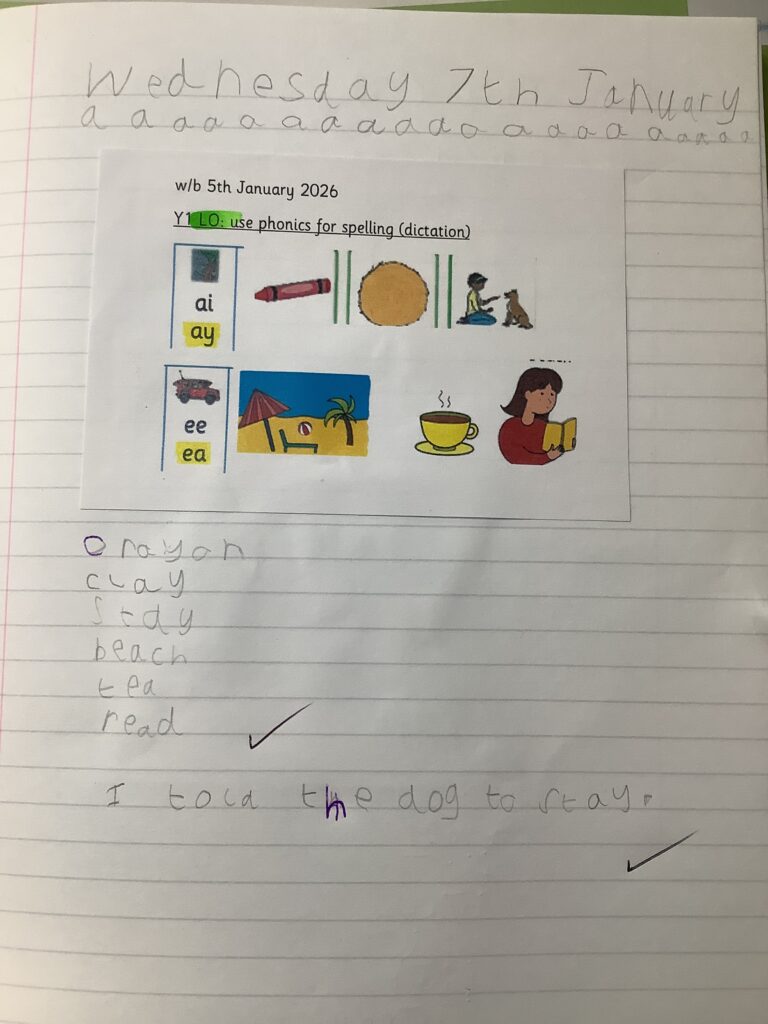
Have you been to one of our class assemblies this year? This week, it was the turn of Class 1,2B (Mrs Latham’s class). Here’s a pic of some wonderful Phonics and Writing linked to the assembly…
The rest of this message is about this half-term’s topic…
What is this half-term’s topic?
This half-term, we’re historians. We’ll be developing our understanding of Britain’s past and the wider world. Children will use enquiry skills to answer questions about the past that require opinions. They’ll be ‘time detectives’, using sources of evidence to help them answer these questions. Each phase has age-related specific knowledge, skills and vocabulary that they’ll learn, use and apply across the topic. See pages 23, 24 and 25.
Years 1 and 2
In this topic, children will learn about how toys and games have changed over time. They’ll develop chronological understanding by sequencing events in their own lives before learning about how toys and games were different during their parents’ and grandparents’ and great grandparents’ childhoods. They’ll look at similar toys from different times and try to sequence them chronologically using logical reasoning. They’ll use photographs and other sources of evidence to identify changes and similarities.
The key historical concept which we’ll explore in this topic is innovation. An innovation is an improvement or replacement for something
Years 3 and 4
In this topic, children will learn about the Roman Empire and its invasion of Britain. It will examine how life changed for the people living in Britain at the time of the invasion. They will learn about the Celtic warrior, Boudicca and how she resisted the Romans. Children will also consider what we know about Boudicca, how we know it and whether we can trust it.
They’ll learn about the amazing inventions and advances that the Romans brought to Britain. Finally, they’ll find out why the Romans left Britain and who the Anglo-Saxons were.
There are two key historical concepts which we’ll explore in this topic: empire and invasion. An empire is a large group of countries or states ruled by an emperor or empress. An invasion is when a country or region is invaded by an armed force.
Years 5 and 6
In this topic, children will learn about Viking Britain and an Early Islamic Civilisation centred around the city of Baghdad around 800AD.
During this period of time, Baghdad was the largest city in the world and was the centre of the world’s trade routes. Trade between Vikings and Baghdad happened and provides a real link between these two societies.
Through studying the Vikings, children will again learn about how people invaded and settled in Britain. Invasion is also relevant as it brought an end to the Islamic Golden Age.
The Islamic Golden Age was a period of great innovation. Learning and knowledge was key to their success. They built the world’s first hospitals, universities and observatories, as well as studied writing from scholars around the world. The contrast with Viking Britain during the Dark Ages is stark!
There are three key historical concepts which we’ll explore in this topic: trade, invasion and innovation. Trade is the exchange of goods and services, initially for other goods and services, and then for money. An innovation is an improvement or replacement for something. An invasion is when a country or region is invaded by an armed force.
Help at home
Talk to your child about what they’ve been learning in class. The class news page of the school website is a good place to go to find out more about what the children are doing.
Find some books from the library which match what the children are learning. This will be quite easy for children in Key Stage 2 as there will be plenty of books about Roman Britain and Viking Britain. You should also be able to find some about the Islamic Golden Age. For children in Key Stage 1, look for some books about toys over time. However, any book that looks at how an aspect of life has changed over time will be good. For example, you may find books about shopping, houses, transport, holidays. These will all help your child to sequence chronologically and explore similarities and differences.
Watch television shows about history. Horrible Histories is great – regardless of your age!
Finally, don’t forget on Monday, we’ve an online session to support you to help your child stay safe online. This is important: very frequently, we’re made aware of unsafe behaviour amongst children when they’re online at home. Join in the Zoom session using the link that has been emailed to parents/carers.