Me and My Community week

This week, Class 3/4C have been taking part in our ‘Me and My Community’ week. The children have been exploring all the different ways we can show respect, both in school and in the wider community. We’ve been thinking about our school rule, ‘We’re Respectful’, and what this looks like in our everyday actions, from listening carefully and being kind to others, to looking after our school environment. We’ve also discussed how showing respect helps us to build a happy and healthy school community where everyone feels welcome and valued. The children have shared some fantastic ideas about how they can make a difference through their words and actions!

Help at home: talk about the different communities you’re part of, whether that’s your family, your neighbourhood, a sports team or a club. What does respect look like in these different places? Can you think of three small things you could do to show respect and help make your community an even happier place to be?
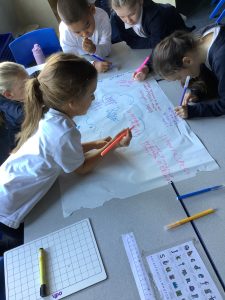
Writing: discussion

This week, Class 3/4C have been preparing to write their discussion texts by taking part in a debate about which of the ancient Greek city-states, Athens or Sparta, should be taught in history from now on. The children did a fantastic job of sharing their opinions, giving reasons to support their choices and practising how to use formal language to put their points across. They also had to listen carefully to different viewpoints and think about how to persuade others that their chosen city-state was the better one. This has given them a great starting point for writing their discussion texts this week.

Help at home: talk about Athens and Sparta together. Which city-state do you think would be the better one to learn about in history, and why? Think about what made each city-state different, including their way of life, education, government and military. Can you come up with a few strong reasons to support your choice?

Maths: Bridging 10

What a fantastic start to the year we’ve had in Class 3/4C! It’s been lovely getting to know the children and seeing them settle into their new routines.

This week in Maths, we’ve been recapping bridging 10 when adding numbers.

Bridging 10 is a useful strategy that helps us to add numbers efficiently. We can use our knowledge of number bonds to 10 to make the calculation easier.

For example:

8 + 5

We know that 8 needs 2 more to make 10, so we can partition (split) the 5 into 2 and 3.

8 + 2 = 10
10 + 3 = 13

Therefore, 8 + 5 = 13.

We could partition in another way, too – ask your child how you might start with the 5 and partition the 8.

The children have been using practical resources, drawings and number lines to help them understand this strategy before applying it to calculations independently. We’ve also been thinking carefully about explaining how we know our answers, rather than simply finding the answer.

It’s been fantastic to see the children becoming more confident with their addition strategies and supporting one another with their learning.

Help at home: Why not practise some bridging 10 calculations together? You could try calculations such as 7 + 6, 9 + 4 or 8 + 7. Can your child explain how they could bridge through 10 to find the answer?