
Writing: discussion
This week, Class 3/4C have been preparing to write their discussion texts by taking part in a debate about which of the ancient Greek city-states, Athens or Sparta, should be taught in history from now on. The children did a fantastic job of sharing their opinions, giving reasons to support their choices and practising how to use formal language to put their points across. They also had to listen carefully to different viewpoints and think about how to persuade others that their chosen city-state was the better one. This has given them a great starting point for writing their discussion texts this week.
Help at home: talk about Athens and Sparta together. Which city-state do you think would be the better one to learn about in history, and why? Think about what made each city-state different, including their way of life, education, government and military. Can you come up with a few strong reasons to support your choice?
Science: animals in our local area study
This week, chidren in year 3/4 have been surveying which vertebrates and non-vertebrates live in our local area. They produced bar charts to show what they managed to spot in a ten minute period.
Help at home: take time to enjoy this fantastic autumn. Go for a nature walk and see if you can spot anymore animals.


What did the Greeks do for us?
We researched three topics in our history lessons this week:
- arts
- science
- sport
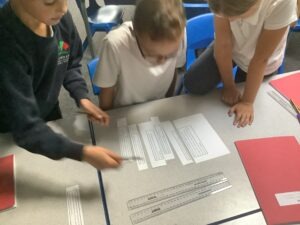
We made notes and then created posters about each subject.
Help at home: with support, continue the learning journey to research more about life in Ancient Greece. Visit the local library and read some more non-fiction books about Ancient Greece.


DT: food and nutrition (egg pots)
We had a cracking time making our egg pots this morning. We recapped the bridge knife technique and learned about expiry dates.
Help at home: allow your child to shop for the ingredients, check expiry dates and cook this snack under supervision. Can they think of any ways to improve the dish?


Living and Learning: rights and responsibilities
This week in Living & Learning we have been learning that we have the right to learn but a responsibility to be great learners. Here is a list of top tips we came up with to be great learners:
- be in class on time
- be prepared for all lessons
- take good care of school property
- complete spelling, reading and talk time homework
- be ready
- respect ourselves and others
- listen and react well
- doing our best – every day!
We also talked about Children’s rights in the UK. These include:

Help at home: watch this video and ask your child what their rights are
Forest School
Our Year 3 children have been playing and learning together in our Forest School area.


Year 4 Multiplication Games
Playing games is a great way to learn. We used a multiplication grid and some 12 sided dice to play Connect 3 (like Connect 4 but better!)


Help at home: ask your child about the game. Can they think of a different version to make it easier or more difficult? Which facts do they find difficult? What can they use to support them with their learning?
On 13th October, we’ll show parents how we play the Connect 3 game in our Watch Us While We Work session. Come along and find out some more games and tips for home learning.
History – Ancient Greece
This half term, Year 3 and 4 are travelling back in time to discover the fascinating world of Ancient Greece.
We started our new topic by looking at timelines and finding out where Ancient Greece fits into history. We also explored the Golden Age of Ancient Greece and why this was an important time.
The children have been learning about Athens and Sparta and how different life was in each city state. We compared their education, daily life and the way people lived. The children then decided whether they would rather be an Athenian or a Spartan and explained their reasons through a debate.



Help at home by asking your child to tell you some differences between Athens and Sparta and which city state they would rather have lived in!
Maths: Bridging 10
What a fantastic start to the year we’ve had in Class 3/4C! It’s been lovely getting to know the children and seeing them settle into their new routines.
This week in Maths, we’ve been recapping bridging 10 when adding numbers.
Bridging 10 is a useful strategy that helps us to add numbers efficiently. We can use our knowledge of number bonds to 10 to make the calculation easier.
For example:
8 + 5
We know that 8 needs 2 more to make 10, so we can partition (split) the 5 into 2 and 3.
8 + 2 = 10
10 + 3 = 13
Therefore, 8 + 5 = 13.
We could partition in another way, too – ask your child how you might start with the 5 and partition the 8.
The children have been using practical resources, drawings and number lines to help them understand this strategy before applying it to calculations independently. We’ve also been thinking carefully about explaining how we know our answers, rather than simply finding the answer.
It’s been fantastic to see the children becoming more confident with their addition strategies and supporting one another with their learning.
Help at home: Why not practise some bridging 10 calculations together? You could try calculations such as 7 + 6, 9 + 4 or 8 + 7. Can your child explain how they could bridge through 10 to find the answer?
Living and Learning: The 8 Rs
This week’s Living and Learning statement is ‘I use the 8 Rs to help me learn.’
We have been discussing each of the 8 Rs and how they are important in supporting our learning. They are:
- being ready
- being responsive
- being reflective
- being resourceful
- remembering
- risk-taking
- being resilient
- being responsible
We then discussed which we felt were most important to us and why.
Help at home by asking your child if they can remember the 8Rs and how they can show them both at school and in the wider community.