
Remote Learning 08.02- Mr Wolf’s Pancakes
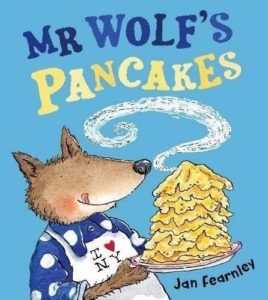
This week, we’re going to find out what happens when Mr Wolf decides to cook some delicious pancakes. Listen to the story ‘Mr Wolf’s Pancakes’ and look at the illustrations in the video carefully as you watch. You might spot some familiar characters!
Here’s are this week’s activities to download in a PDF.
Reading
- Can you spot any other story characters that you recognise? Which story are they from? Have you read it?
- Why does Mr Wolf need some help at the beginning of the story?
- Were Mr Wolf’s friends helpful and kind? Why do you think they didn’t want to help?
- What happened when Mr Wolf started to cook his pancakes?
- Can you remember what happened at the end of the story? Do you think Mr Wolf should have shared his pancakes?
Phonics
Being able to copy a rhythm is part of our Phase One phonics learning; we often play simple ‘copy me’ type games as we’re waiting to wash our hands. Today, you’ll need two sticks or wooden utensils, or anything else that is similar! Listen to Mrs Gosper and then have a go at tapping the rhythms too.
Phonics – Rhythm pattern sticks
Mark-Making
- Mr Wolf said he wasn’t very good at writing. Can you help him write out a shopping list for going to the shops? What does he need to make his pancakes?
- If Mr Wolf wanted to have a pancake party and invite some friends to his house, what would he need to send them? That’s right, an invitation. Perhaps you could plan a Pancake Day party for next week and make some invitations to send to people in your house.
- Have a go at drawing or painting your favourite type of pancake. What toppings would you put on it?
- Open up your own ‘Pancake parlour’ and take orders. You’ll need to write down and tick off what your customers would like on their pancakes.
- Have you remembered it’s Valentine’s Day on Sunday 14 February? Why not make a card for someone in your family or see if you can post one to someone special that you might not be able to see at the moment?
Mathematics
This week, we’re going to practise our counting skills. In the story, Mr Wolf made lots of pancakes and we thought it’d be fun to make our own playdough pancakes. If you don’t have any dough, you could follow this simple recipe and have a go at making your own. Whilst making pancakes and playing, you could introduce ‘counting’ in different ways.

- How many pancakes have you made? Count each pancake, touching them as you say each number. Sometimes it helps to line objects up to ensure that you count each one only once and try to remember to stop at the last pancake. How many were there? Count again to make sure.
- Have you got more pancakes than me? How do you know?
- Who has the fewest pancakes? Children often understand the word ‘more’ or ‘most’ but struggle to understand the word ‘fewer’ or ‘fewest’.
- The Little Pigs are going to Mr Wolf’s house for a pancake party, how many pancakes do we need to make? Think about your child’s ability and keep the numbers below 5 or 10 as appropriate.
Extension ideas
- Introduce some real coins into your game. Children don’t need to be able to tell you what the denominations are in Nursery, they may just give you a handful of coins or some may count out 3 coins (of different values) and say “Here’s £3”. It’s all a great way to introduce and familiarise them with money. You could look at the different coins and try to sort them. How could you sort them? Big/little? Circle/not circles? Copper/silver?
- Do you remember playing ‘What time is it Mr Wolf’ at school? Children love to play this at Nursery still and it’s a good way of practising counting out the correct number of steps.
Creative
- We couldn’t read Mr Wolf’s pancakes and then not suggest that you make some pancakes! It’s a great, simple recipe for children to join in with and whisking is great for building upper arm strength too.
- What’s your favourite topping? Do you always have the same one? Use this as a time to try something new and talk about different flavours. Do you have sugar and lemon or golden syrup? Is it bitter/sweet/sour?
- With supervision, ask children to help you cut some soft fruit to put on their pancakes such as bananas or strawberries. Talk to them about using knives safely.
- If you don’t mind a bit (or lot!) of mess, allow your child to enjoy ‘play baking’ pancakes with some flour, water and mixing bowls.
- Join in a role play game and make your own ‘Pancake Parlour’ using some of the mark making and maths activities at the same time.
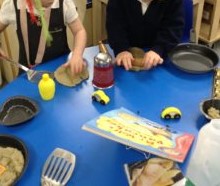
If you have a play kitchen, you could cut out some cardboard pancake shapes or you might want to use playdough instead. Take turns to order, cook and pay for your pancakes. If you don’t have a play kitchen, have a go at making one. It doesn’t have to be fancy or take a long time; at Nursery, we sometimes make ovens/hobs using a cardboard box with some circles drawn on top. Children always love to use ‘real’ objects so grab a frying pan and spatula and let them pretend!
- There are lots of songs about cooking pancakes! Here’s a Pancake rap from CBeebies and a Pancake rhyme to join in with Mrs Gosper.
Understanding the World
- Part of the Early Years Foundation Stage is to begin to recognise some of our family traditions and celebrations and to begin to recognise how we are similar and different to others. In Nursery, teaching children in detail about Shrove Tuesday is too complicated, but we do talk to them about how Christian’s might celebrate this day and that it’s sometimes referred to as ‘Pancake Day’. We discuss that some families will celebrate by making pancakes and that others might not. We talk about it being a time where Christians begin to prepare for another special day, known as Easter.
- If you have a laptop or a device that supports the game, let your child practise some simple computer skills by playing this game. You need to help Curious George make some pancakes and add his toppings. How many eggs will you need and how many strawberries does George put on?

- Talk to your child about the ingredients in pancakes and ask them to think about where they come from. One of the most common answers is usually “the supermarket”! Try to find out more and talk about the origins of milk and eggs by watching these videos. One is all about milk and the other is an episode of ‘Do You Know’ where Maddie finds out about eggs and bread.
How does milk get to the farm shop?
Physical Development
Fiddly Fingers
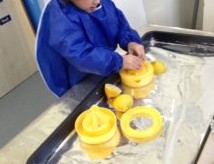
In Nursery, we always get lemons to squeeze when joining in with pancake day celebrations. If you have a lemon squeezer and can add an extra lemon or two to your basket, we’re sure that you’ll enjoy squeezing lemons and talking about what’s inside the lemon. This is also a great activity for strengthening little fingers!
Another good activity for helping to build strength in children’s upper arms, is ‘whisking’. You can do this whilst making pancakes but you could also let your child play with some soap and water and enjoy whisking it to see what happens. If you don’t want lots of mess around the sink, try it at bath time instead.
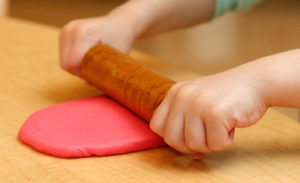
Also, remember that playing with playdough is a great way to develop finger and arm strength. So, using a rolling pin to flatten playdough to make pancakes is another good activity to do. Tip: If your child is struggling to put enough pressure onto the rolling pin to flatten the dough, try asking them to stand up and do it on a surface/table at their height.
Movement
The weather is very unpredictable at the moment, so taking part in a pancake race may or may not be possible! If you have space inside/outside and a frying pan/tennis racket, make a play pancake or use a bean bag to see if you can move around an obstacle course without dropping it!
Lots of you emailed to say that you enjoyed the Cosmic Yoga session so here is another, all about something you might enjoy eating on top of your pancakes – bananas! Cosmic Yoga – Betsy the Banana
Independence skills
During lunch time at Nursery, children are encouraged to be as independent as possible. This might involve knowing how to feed themselves when they’re given a meal or snack, learning how to put a straw into a carton or being able to open a sandwich box. Children that have a hot meal at Nursery are also encouraged to be able to use a knife, fork and spoon to feed themselves. Whilst lots of family meal times may involve finger foods, being able to use a knife and fork is an important skill to learn for when your child starts in Reception.
This week, depending on your child’s abilities, have a go at encouraging them to do the ‘next step’ themselves. This might mean taking the top off a yogurt pot by themselves or for other children, it could be learning to use a knife to cut something soft, like a fish finger, into smaller pieces.
If you wanted to practise using a knife and fork outside of meal times, have a go at chopping up your playdough pancakes!
Key Worker activity and videos
This week, we’re going to help Mr Wolf with his counting. He has lots of friends that would like to eat his pancakes but he needs some help to count how many he needs. To join in with the second part of the Key Worker session, you’ll need to sit at a table and have some playdough. (If you don’t have any playdough, cut out some paper pancakes and use those instead.)
Key Worker session part I – Mr Wolf’s Pancakes
Key Worker session part II – Mr Wolf’s Pancakes with playdough
Friday Story Time
This week’s story is also about pancakes! Listen carefully and then see if you can remember some of the toppings that Buddy’s family had on their pancakes. Story time – Buddy’s Pancakes
Zoom sessions (for children learning at home)
For our Zoom meeting this week, you’ll need a small blanket/towel and a small, soft toy. Make sure you have some space and somewhere to safely position your device (mobile/laptop etc) – we’re going to be bouncing our toys!
Happy Friday!
Hello Year 5/6! We hope you are all well and feeling happy and healthy. You’ve made it through another week of home learning, so congratulations. We hope you are going to spend the weekend relaxing, getting some fresh air and having some lockdown fun.
Thank you to people who are still emailing their work in, we love to see what you’re producing at home.
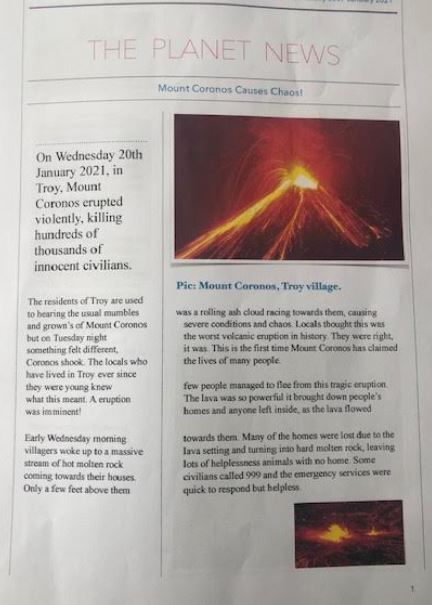
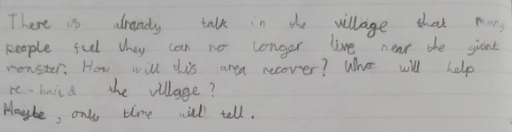
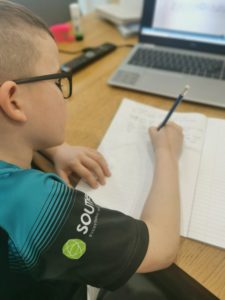
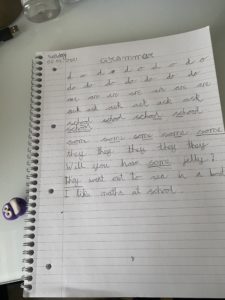
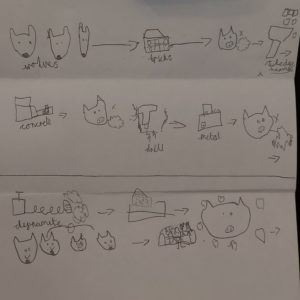
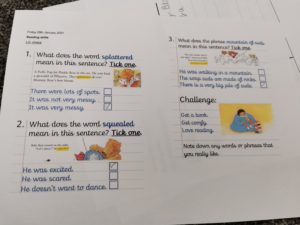
Imogen has sent in her piece of writing in. This is from Mr Owen’s writing lessons and she has produced a great witness statement – well done. She has also been very creative and used play dough to show the different phases of the moon for Mr Freeman’s lesson.


Amazing Writing!
It’s lovely when people send in their learning – as teachers, we really want to see it!
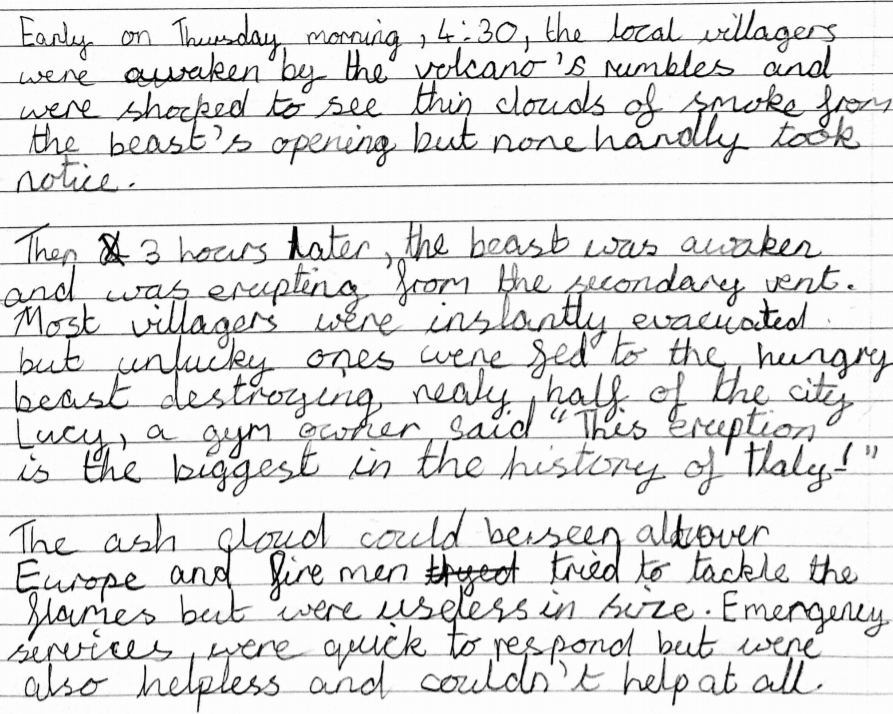
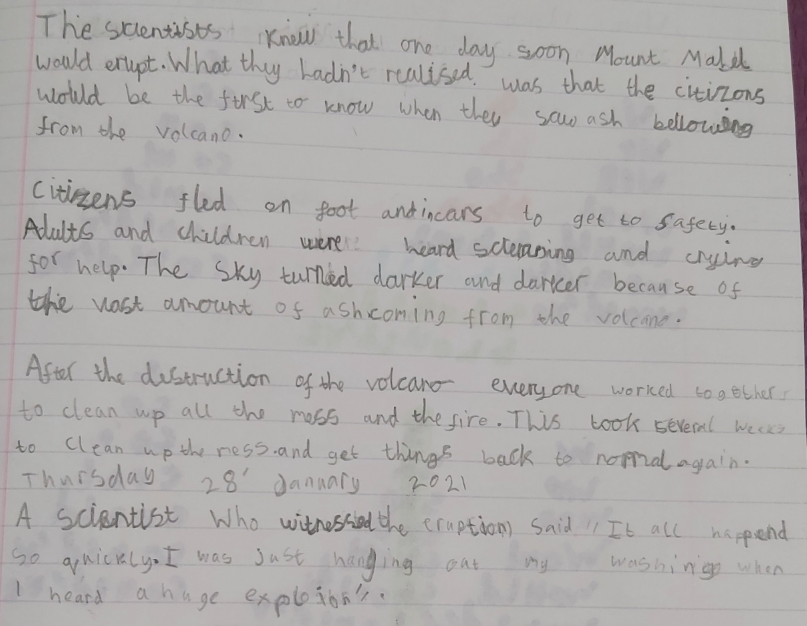
Thanks to these superstars who have sent in their writing recently. There’s lots of things I love about these pieces – pay particular attention to the impactful vocabulary and the varied sentence starters. Well done, everyone!




Home learning superstars
Thank you for the emails showing us what amazing home learning you are all doing. Well done and keep going as much as you can!
Try to email your teacher (addresses below) or bring learning to show at your daily Zoom meetings at 2pm. Email your class teacher if you need the invite re-sending.
1KN Miss Lowry/Mrs Lake : kaylowry@spherefederation.org and natalielake@spherefederation.org
1,2V Mrs Latham : vickylatham@spherefederation.org
2C Mr Gathercole : carlgathercole@spherefederation.org



3,4 NV Class News
Hi everyone,
I hope that you are all keeping happy, healthy and safe. It has been great to hear from so many of you through our zoom chats and phone calls home. Well done to those of you who have emailed me your work. I know you are all working really hard at home – keep going, you’re doing an amazing job!
Keep up with the fabulous efforts on TTrockstars and Numbots. I am checking weekly to see who is using it! Why not have a go on it today?
Here are a few pictures from some of our home learners over the last couple of weeks.
Take care,
Mrs Wadsworth


Message from Boris
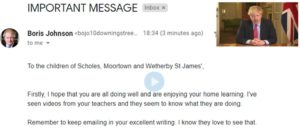
I hope everyone managed to see the message from Boris yesterday. It was the introduction to the writing texts learning for the week. Even if you don’t do all the lessons, the message is worth watching!
IMPORTANT MESSAGE FROM BORIS JOHNSON
Newsworthy writing
From Mr Catherall, who is leading the Y3,4 home learning writing sessions…
Hi everyone
I hope you’re all happy, healthy and safe. I wanted to share with you – and celebrate – some of the awesome writing that’s been sent in by children across our federation. Home learning is tough. There are many challenges, for children and adults, but these superstars have been ready, resourceful and resilient learners. (Can you remember the other 8Rs for learning?)
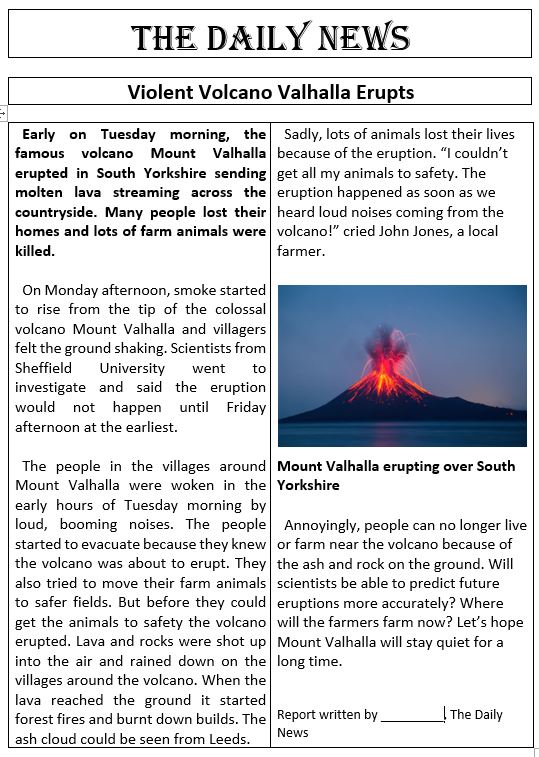
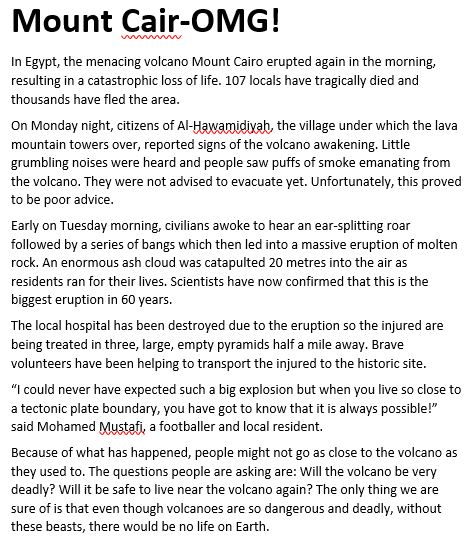
In the Y3,4 phase, we spent last week building up to writing our own news report about a (made-up) volcanic eruption. This links to our geography and science learning.
Here are a small selection of the wonderful examples we’ve been sent in from all three schools. If you’d like to send yours in, I’d love to see it (send me an email – olliecatherall@spherefederation.org).
From my class at Scholes (Elmet)… I love the varied sentence starts in this one (Late on Friday night, On Saturday, In the escape).
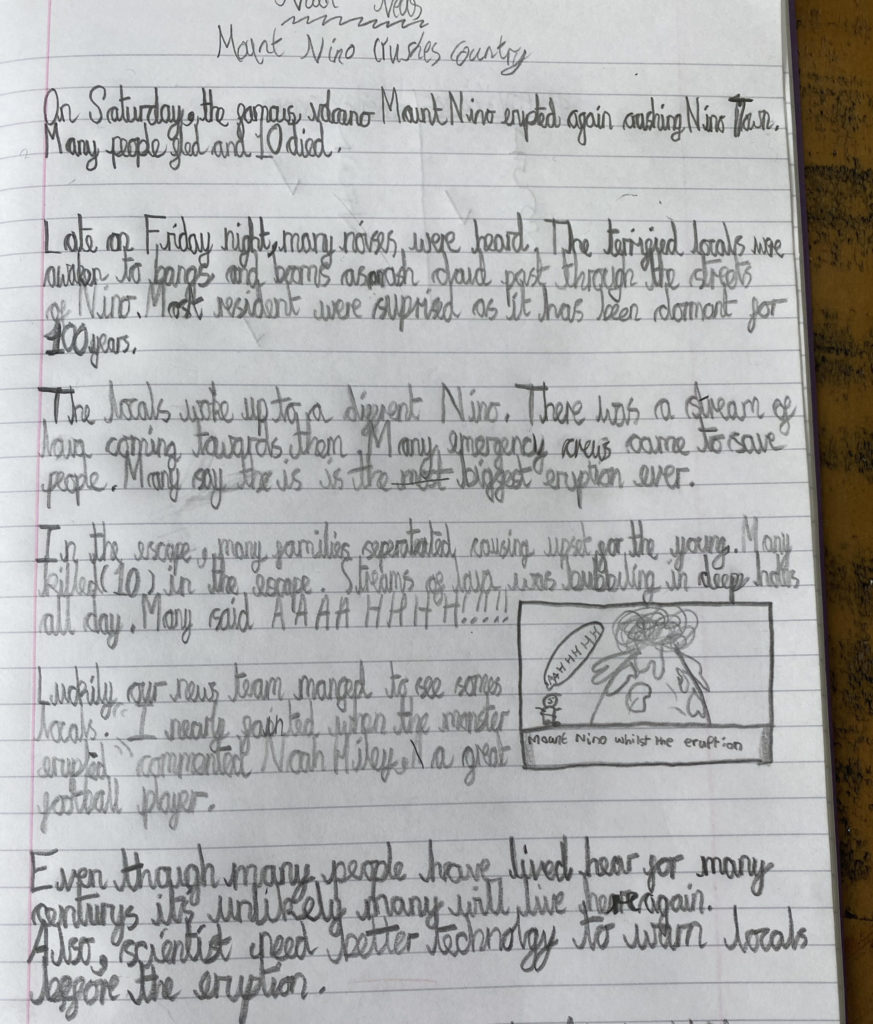
We’ve got a budding journalist at St James’ CE… I really like the news report structure here.
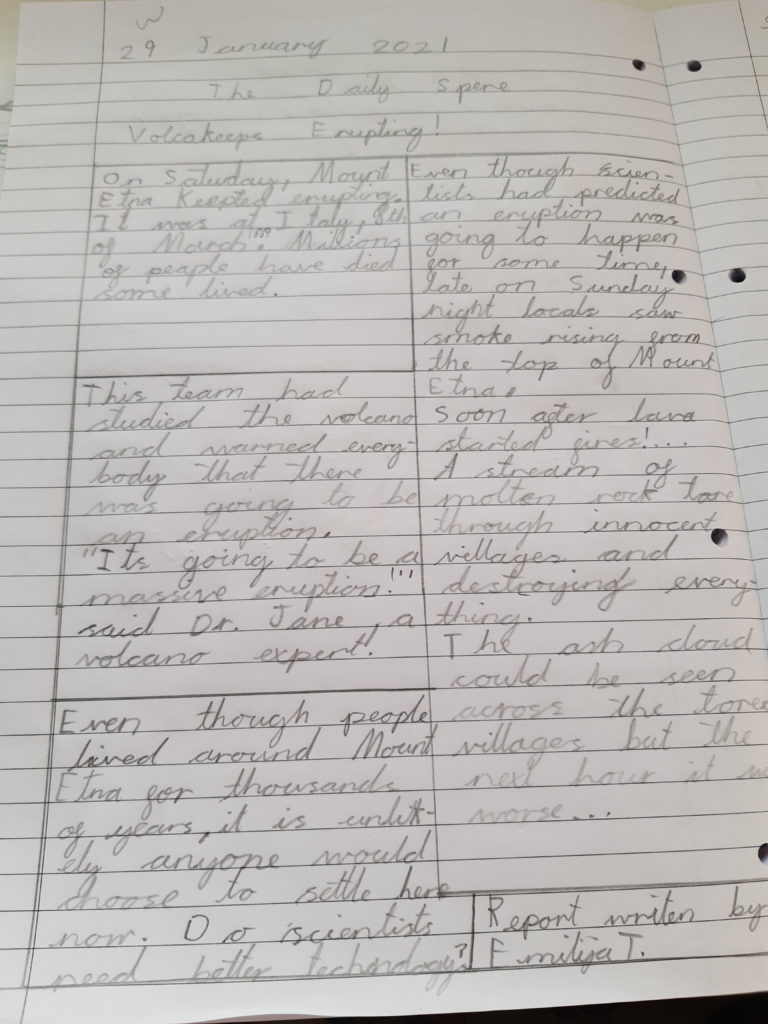
Back to Scholes (Elmet) for some another great piece… This time, I really like the main news section (the first paragraph in bold) because it’s exactly like you’d read in a newspaper or online.
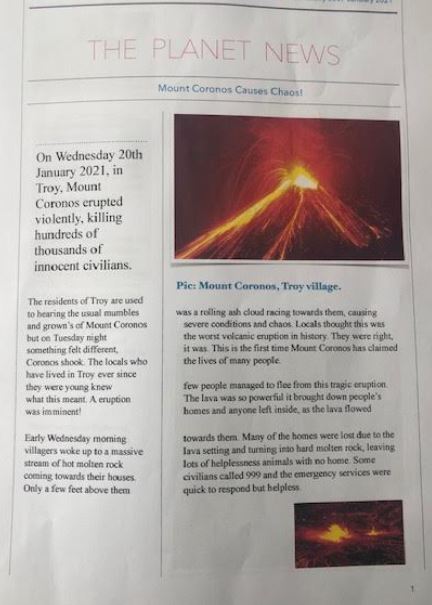
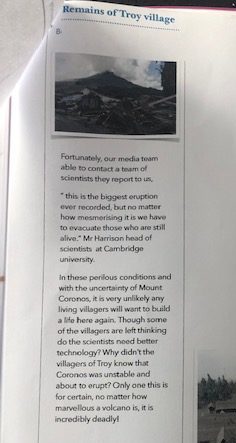
Some amazing writing from Moortown… I love the expanded noun phrase (the orange, glowing liquid) and the vocabulary (predicted, nightfall, terrified) in this one.
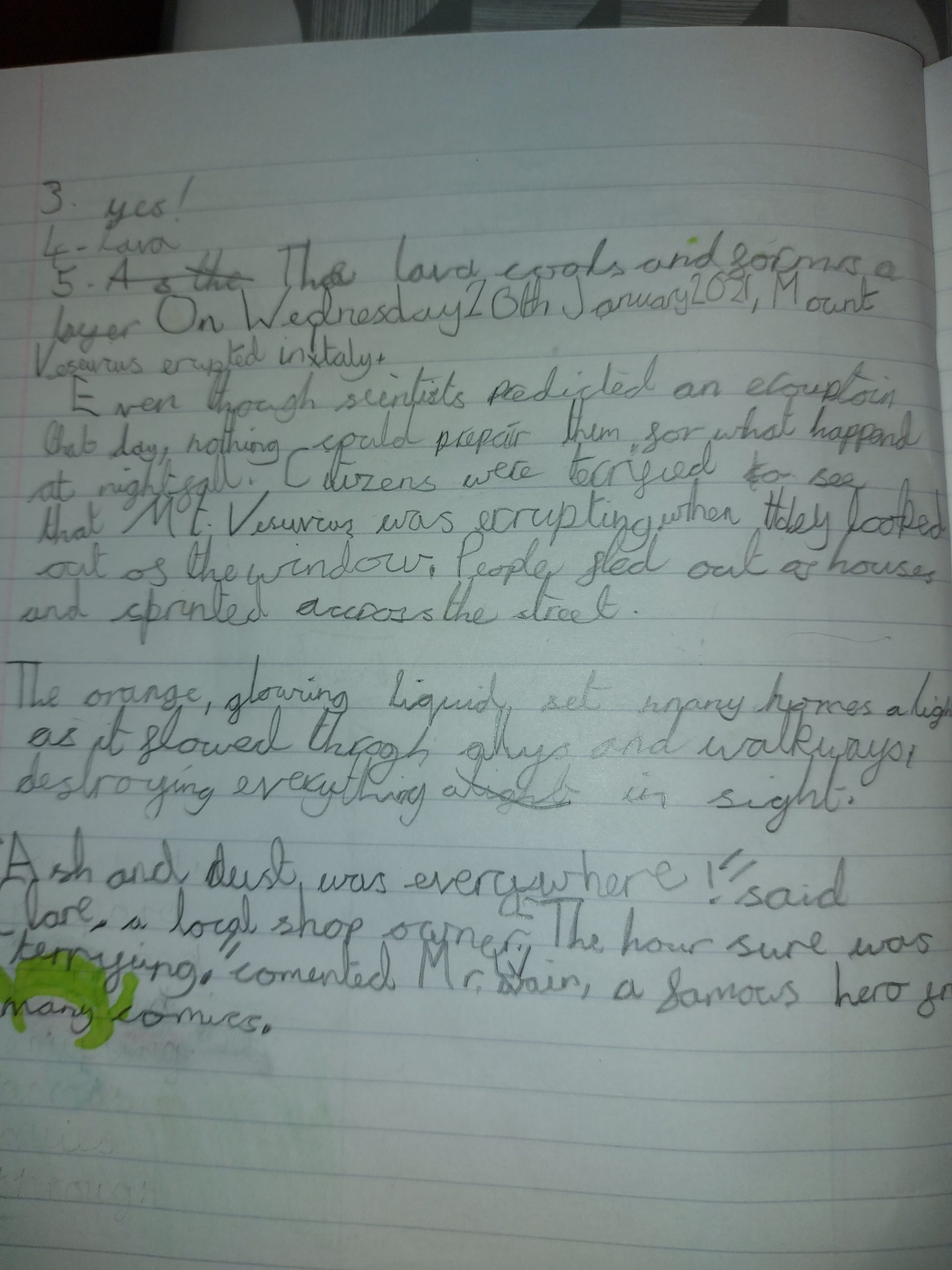
Another super piece of writing from my class at Scholes (can you tell I’m proud?!)… There’s a lot to celebrate here – particularly the vocabulary (menacing, catastrophic, awoke, ear-splitting, historic)…
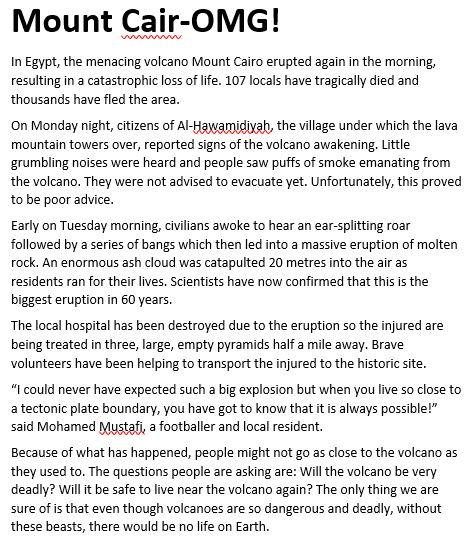
Back at Moortown for another great example of journalistic writing… I particularly enjoyed the use of questions to engage the reader and the way this writer has presented their news report in the style of a newspaper.
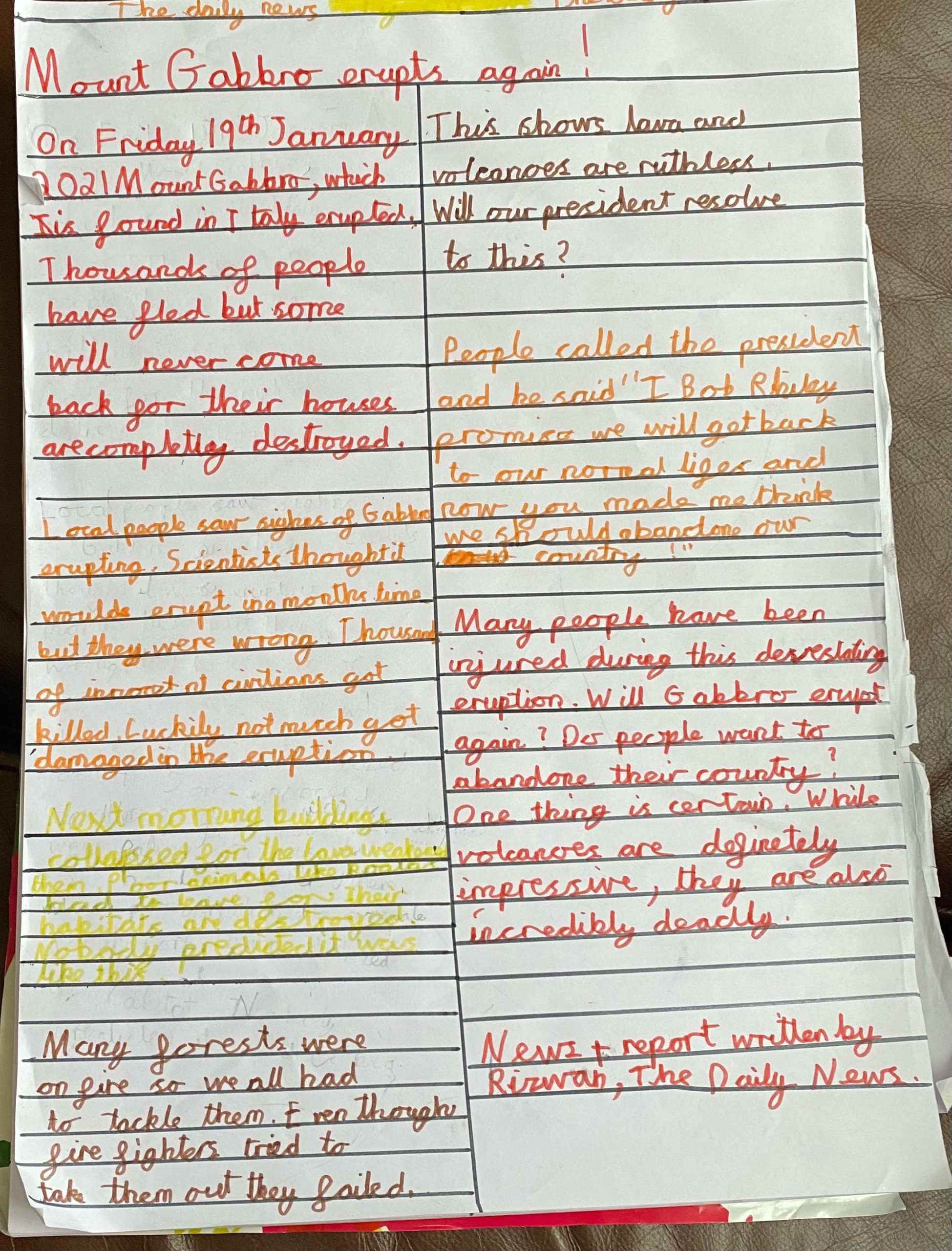
Another impressive report from Scholes… In this one, I love the vocabulary (citizens, fled on foot, vast amount).
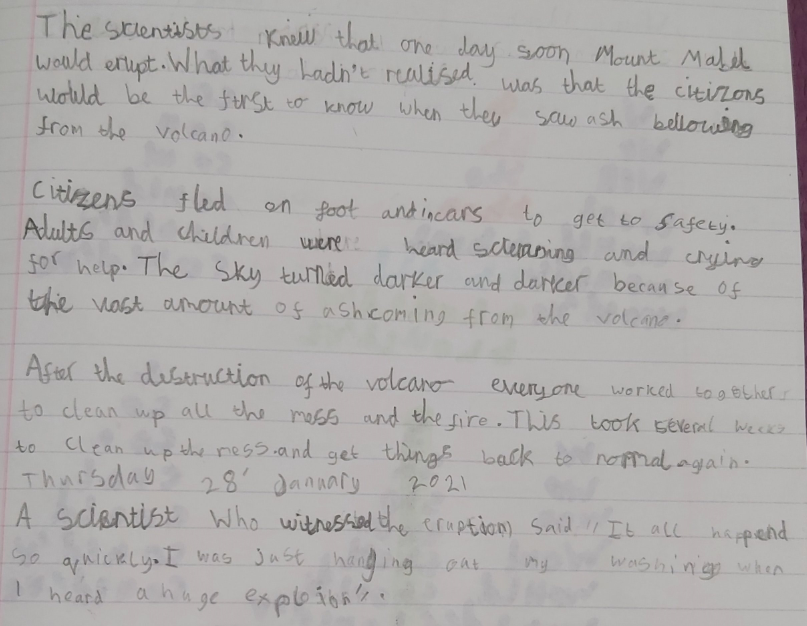
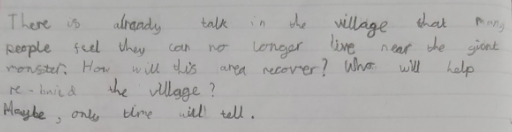
Whatever writing you’ve managed to do at home, well done! After the last lockdown, writing was one of the few areas that we noticed children hadn’t progressed in. Try to help by completing at least one of the writing lessons each day (and always keep a focus on handwriting).
Three Peaks in eight weeks – walking challenge!
The Sphere Year 3/4 Team would absolutely love you to be part of this awesome challenge this February and March. We want to get you walking or running (or scooting!) as much as you can over the next two months.
Every time you do a walk or run, add the distance completed (and your time taken to complete this) in your chart. We will be adding up everyone’s distances each week to see how many of us can ‘climb’ the National three peaks. In topic this week and next, we will be learning about some mountains in the UK, so what could be better than a virtual mountain climbing challenge!
The three mountains in the challenge are the highest in each country in the UK:
- Snowdon, in Wales (1085m) Distance: 7 miles / 11.75 km
- Scafell Pike, in England (978m) Distance: 5.5 miles / 9 km
- Ben Nevis, in Scotland (1345m) Distance: 10.75 miles / 17km

You can record your steps taken (paces). The whole route is 37.75 kilometres long, and the average human step (or pace) is 0.75 metres. So you have to take 50,333 steps in total to complete the Three Peaks. Recording steps (paces) taken is easy – you can use a Fitbit, pedometer or just count your steps. A phone can track how many steps you take and how far you walk all by itself, if you walk with an adult who has a phone.
The idea is to make this as much fun as possible, to motivate you to get outdoors and maybe encourage as many of your family and your friends to do the same thing.
You don’t have to do the whole route. Maybe you can choose to ‘walk’ just one mountain, or two – it’s up to you and what you can achieve.
Throughout the month, we will share photos and graphics of the distances you’ve travelled. From this, we can show who has travelled up the peaks and what location we can reach together. Hopefully, we can find ways to help you during this challenge and through this you can share stories, pictures and videos with those joining in this challenge. All ‘Three peaks in eight weeks’ challenge walkers will receive certificates for effort and participation:-
Mountain 1 = Bronze; Mountain 2 = Silver; Mountain 3 = Gold.
Children’s Mental Health Week
Children’s Mental Health Week is taking place on 1-7 February 2021. This year’s theme is Express Yourself.
Here are some activities and ideas for you and your child(ren) to complete at home together. You can also download it here.

Expressing yourself is about finding ways to share feelings, thoughts, or ideas, through creativity. It is about finding a way to show who you are, and how you see the world, that can help you feel good about yourself.
As parents and carers, you play an important role in your child’s mental health. Check out the free resources.
Don’t forget to email your teachers with any photos or messages of your activities about Children’s Mental Health Week.
Thank you!
Week Commencing 01.02.20: Home Learning
| Monday
|
Book of the week- Click here to watch the story Dear Zoo or read the book if you have it at home.
Questions to discuss- Why was the elephant sent back? Which animal was described as being too fierce? Why do you think he kept the puppy and not any of the other animals? |
| Phonics- th
Click here to watch today’s phonics video Activity 1: Look at the picture. What can you see?
Parents: Read this sentence aloud – A moth on the grass. Activity 2: Have a go at blending the phase 3 ‘th’ real and nonsense words. Click here to either print it, or view on screen. |
|
| Maths- White Rose Maths: Growing 6, 7, 8!- Week 2.
Click here to be taken to the correct web page. Choose Session 1. Activity: Click here for today’s activity. If you do not have a printer, draw and make your own memory cards. This will work just as well for the activity! |
|
| Tuesday | Phonics- ng
Click here to watch today’s phonics video Activity 1: Play Musical Blending. Activity 2: Read the sentence and have a go at writing your own sentence using one of these words. |
| Maths- White Rose Maths: Growing 6, 7, 8!- Week 2.
Click here to be taken to the correct web page. Choose Session 2. Activity: Click here for today’s activity. Take photos of your pairs and send them to your class teacher(s). |
|
| Wednesday | Phonics- ai
Click here to watch today’s phonics video Activity 1: Play the Picnic on Pluto game on Phonics Play. Activity 2: Look at the pictures on this document. Segment and write the words to match the pictures. You could print these phoneme frames, or draw your own. Parents: If you are unsure, click here to view the words. |
| Maths- White Rose Maths: Growing 6, 7, 8!- Week 2.
Click here to be taken to the correct web page. Choose Session 3. Activity: Click here for today’s activity. |
|
| Thursday | Phonics- Tricky word – my
Click here to watch today’s phonics video. Activity 1: Tricky Word Puzzles 3. Can you put the letters in the correct order?
Activity 2: Tricky Word Hunt Activity 3: Rainbow write tricky words. Choose some bright coloured pens or pencils to practise spelling all of the phase 2 tricky words (the, to, I, no, go, into) and the phase 3 tricky words you know so far (he, she, we, me, be, my). Below is an example of how to do rainbow writing.
|
| Maths- White Rose Maths: Growing 6, 7, 8!- Week 2.
Click here to be taken to the correct web page. Choose Session 4. Activity: Click here for today’s activity. If you do not have a printer, you could draw your own domino circuit. This will work just as well for the activity! |
|
| Friday | Understanding the World with Professor Myers; Friction Experiment-
Click here to watch this week’s video with Professor Myers. -Using a variety of toys, carry out your own friction experiment. Before you carry out your experiment, remember to predict which toys you think will travel fast or slow. You could sort them into two groups. – After the experiment, draw and label your results. |
| Story time- The Tiger Who Came to Tea with Mrs Kirby
Questions to discuss: 1.Imagine if a different animal came to tea. How would they behave? 2.How would your family react if a tiger wanted to come to tea? 3.The author uses the words ‘big’, ‘furry’ and ‘stripy’ to describe the tiger. Can you think of any more adjectives? 4. The tiger wasn’t very polite when he ate all of Sophie’s food. Can you think of some manners that he should need to remember when he visits someone else’s house? |


Story Link activities to select throughout the week
Literacy
- In class, use Talk4Writing actions to help us retell and act out the stories we learn. After listening to the story, see if you can come up with some actions. You could get an adult to record you and send it to your class teacher!
To help you get started, click here to watch an example. - Dear Zoo is a ‘lift-the-flap’ book. Make your own ‘lift-the-flap’ book. You could choose your favourite animals to be underneath each of the flaps. Then, write a sentence underneath each flap. For each sentence try to write the name of the animal and a describing word.

A writing reminder…
How did your child find the writing activity? Remember, it’s okay for things to be spelt phonetically. It is important that your child grows into an independent learner. Encouraging your child to write the words as they sound rather than always spelling them correctly. We encourage the children to use their own skills, rather than copying an adult.
Understanding the World
Choose an animal from the book. With the help of an adult, research and find out information about that animal.
Where is its natural habitat? What does it eat? What does it like to do? When the animal lives in a zoo, what does a zookeeper need to do to look after it?
You could use this website or find one of your own.
Maths
1. Choose two or three animal toys. Go on a hunt around your house for different containers. Explore which containers your animals will fit in. Can you explain why they fit in some containers but not others?
2.Patterns are everywhere! Can you recognise any of these animal patterns? Draw your own animal pattern on a piece of paper.
Expressive Arts and Design
Make a lion mask.
Resources:
Paper plate
1 sheet of yellow and orange paper
Scissors
Glue
Instructions:
1. Cut out the inside of a paper plate, leaving only the outside circle.
2. Cut strips of yellow and orange paper.
3. Glue the yellow and orange paper to the paper plate circle, creating a lion’s mane.
4. Make sure they give a loud ROAR!

Physical Development
- Get moving and dance along to these songs!
- Make a paper chain snake. This is a great funky fingers activity!
Resources:
Paper (any colours you’d like to use)
Scissors
Stapler
Glue
Googly eyes
Instructions:
1. First, decide on which colours you want to use. You could use two or three colours and try to make your snake a repeating pattern, for example, red, orange, red, orange.
2. Cut strips of each colour.
3. With an adult, use a stapler or glue to connect the chains.
4. Add a head by cutting out a triangle and gluing it to the first chain. You could also add a tail!
5. Glue googly eyes on the head and add a red tongue, then you’re done!

Zoom
To make sure you are prepared and ready to get your fingers moving, use this simple recipe to make some dough at home.