
Father time: A character description
Here are some desriptions from our reading lesson today.
John’s blue scarf thumped up and down on his chest while his heavy, green wellington boots slowly slithered up the road. His camo hat helped stop the rain from beating heavily on his head. A ragged bag slung over his shoulder as he trailed on down the cobbled road. A stonewall, icy cold from the bitter air, stood tall while foogy mist crept by.
By Elizabeth
Nobody knows why but the weather changes depending on what John is feeling. The foggy, misty air seemed to swallow him whole and he suddenly became extinct from the world. All you could hear was the clocks- tick, tock, tick, tock. The sound faded to a nothingness.
By Madsion
Mark trudged along the cobbled road. Pulling the clock-filled sack onto his aching back, he sighed wearily once again. The sky was a foggy, dismal cover of rain. His beige coat with a broken zip had lost its purpose – just like him. His wife’s bright, blue scarf was his last good memory of her. Now, it warmed his neck and soothed his shattered hat.
By Eve
Walking down the uneven street, the damp air breathed across Johnny’s face. The foggy downpour of rain had taken over the day and all he wanted to do was to snuggle up in his bed. His bag was soaked through and his hat covered his sad eyes. Countless clocks sung in harmony made him think back to all his sunny memories.
By Olivia
18 June 2020: Home learning
Phonics

Maths
1.Watch the Numberblock14 video.
2.Mathematical graphics – Can you draw 14 in different ways? Can you tell a number story about your picture?
Things your child could draw to show 14:
- 14 monkeys jumping on a trampoline
- 14 stars in the sky
- 14 rainbows
- 14 hearts
Challenge: Use objects at home to solve the following problem. Is 14 an even or odd number? How do you know?
Literacy
Book of the week: The monkey puzzle
1.Listen to the story of the week.
2.What happens in the story? What are the events?
3.Retell the story to a grown up or draw a story map of events.

Reading
Reading daily is an important part in supporting your child’s reading development.
We know most parents have been using oxford owls free ebooks to get their child to read daily – fantastic! Typically, a child in reception would be reading ‘Oxford Level 2/3‘, ‘Letters and sounds – phase 3/4’ and ‘Book band Red/Yellow/Blue’.
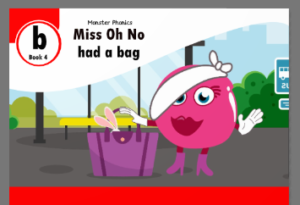
It might be that you are starting to get through most of the ebooks available that are appropriate for your child’s reading level. If so, here are some more free downloadable books that your child could enjoy. Click on the pictures to download the ebook.



To challenge your child further you could ask your child questions about what they have read. This is a great way to see if your child has really understood the story – encouraging your child to read for pleasure! The following resources are great conversation starters when encouraging your child to talk about what they have read.
Leiyah’s Hospital
Leiyah has entered a competion to design a new hospital. Her ideas are fantastic. Take a look here.
Isn’t it nice when things just work!
After watching this video, we decided to make our own. Just another normal day in 5/6M.
Can you do any better? Send your effort to your class teacher.
17 June 2020: Home learning
Phonics
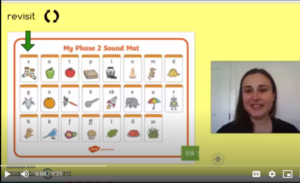
Practise recognising and saying all the sounds.
Words to Read:
Use your ‘phoneme fingers’ to help blend the words. How many sounds are in these words?

Words to Write:

You could draw a phoneme frame in your exercise book to help you remember all the sounds.
Challenge: Can you write a sentence using these words?
Phonics Activity:
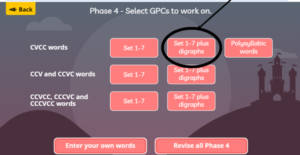
Phonics play – dragons den – phase 4 – CVCC – Set 1-7plus digraphs
Challenge: have a go at reading the polysyllabic words instead.
Maths

Literacy
Book of the week: The monkey puzzle
1.Listen to the story of the week.
2.What is the setting? Where is the story set?
3.Draw the setting of the story. This will be the background for your puppet show. Here is an example of a setting you could draw.

Minibeast – Guess Who?
Today, we have a couple of fun activities for you to join in with. The first, is a game of ‘Guess the Minibeast’! We’ve all thought of 3 clues to describe a minibeast; your job is to listen carefully to the clues and to try and guess which minibeast we’re thinking of. Make sure you listen all the way to the end of the video to hear the answers. You’ll also be VERY pleased to see a familiar face that you might have been missing over the last few video posts.
Did you enjoy seeing Miss Backhouse again? We’re sure that you did. If you visit the Class Page again on Friday, you’ll be able to join in with Miss Backhouse’s story time too.
For the second activity, we’d like you to go on a minibeast hunt. See how many different types of minibeast you can find in your garden or go on a walk. There are some tips on where to find minibeasts on this website and a minibeast hunt sheet if you have a printer. If you don’t, you could simply draw/write down a list and tick them off or draw a picture of the different bugs as you find them. Alternatively, you could use a camera and take a photograph of them.
Let us know how you get on!
Similarities and differences
Finally, we know that some of you enjoyed listening to the story last week which was about celebrating the similarities and differences between people. Stories are a really good way to introduce and talk about important issues in a child friendly way. This week, we have another story that you might like- it’s called ‘It’s Ok to be Different’. It’s all about accepting that it is ‘ok’ to be different or to want to do different things to others.
16 June 2020: Home learning
Phonics
Phonics play – tricky word trucks – phase 3/4
Maths
1.Watch the Numberblock 14 video.
2.Can you do 14 hops, claps, jumps? Remember to count each movement and stop at number 14.
3.Write the numbers 0-14 on the floor using chalk, paint or write on paper (make sure they are big enough to stand on).
4.Can you find the answers to these problems?
Find and stand on the number that is 1 more than 13
Find and stand on the number that is double 7
Find and stand on an odd number
Find and stand on a number that is fewer than 8
Find and stand on a number that is more than 10
Find and stand on an even number
Find and stand on the number that is half of 12
Challenge: Parents/carers give your child some more problems to solve or can your child think of their own number problem?
Literacy
Book of the week: The monkey puzzle
1.Listen to the story of the week.
2.Who are the characters in the story? Who is in the story?
Mum Monkey, Dad Monkey, Baby Monkey, Butterfly, Elephant, Snake, Parrot, Frog and Bat.
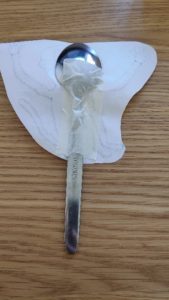
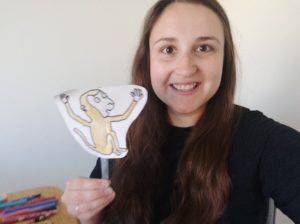
3.Make puppets for some OR all of the characters. Here is an example of a puppet you could make. The puppets you make will be used for your puppet show on Friday.
You will need paper OR card, colouring pencils and sticks OR spoons.
Here Mrs Flynn used a stick she found outside to hold up the puppet. She used the back of an old birthday card to draw the butterfly on.


If you can’t find any sticks you could use a spoon instead – just like Mrs Flynn has here. This time she used paper to draw the monkey on.
15 June 2020: Home learning
Phonics
Practise recognising and saying all the sounds.
Phase 2 or Phase 3
Words:
Phonics Activity:
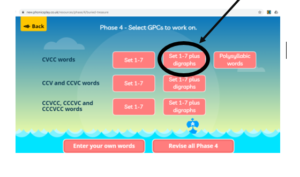
Phonics play – buried treasure – phase 4 – CVCC – Set 1-7
Maths
1.Watch the video and count backwards from 20 to 0.
Today you will need:
- colouring pencils and paper or chalk and some outdoor space
- 0-13 number flash cards
2.Parents/carers can you hold up and say a number. Children can you draw that many spots either on paper or on the ground.
3.Look at how you can draw x amount of spots in different ways. E.g. you could draw 6 spots by drawing 2 at a time or by drawing 3 spots and then 3 more.
4.Parents/carers ask the children some questions about each number as you go along e.g. what is 1 more/less, what is double… or half…?
Literacy
Book of the week: The monkey puzzle
1.Listen to the story of the week.
This week we are going to be looking at the characters, setting and events in the story. This will then help us retell the story using homemade props.
2.What do we mean when we say character? Setting? Events?
Answer:
Character = Who is in the story. The people/animals in the story.
Setting = Where the story is set.
Events = What happens in the story.
To join in with this week’s creative literacy activities, you will need the following items. Hopefully, these are items you will find in your home.
- Paper OR card and colouring pencils
- Sticks from outside OR a collection of spoons (they can be re-used afterwards)
- Sticky tape
Perhaps if you are going outside for your daily exercise today you could collect some sticks.
Reflection
Your child may be asking questions about recent events in America and subsequent protests across the world.
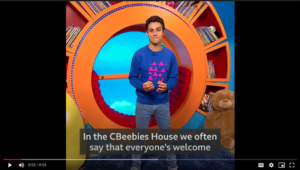
‘Everyone’s welcome’ by CBeebies is a great resource to help you begin to talk about these recent events with your child.
Sesame Street have also shared a story ‘We’re different, We’re the same’.
This is a great opportunity to teach tolerance, mutual respect and acceptance to others. It promotes empathy and understanding; encouraging your child to consider what makes themselves and others special, valuing the similarities and differences between themselves and others.
What the Ladybird Heard
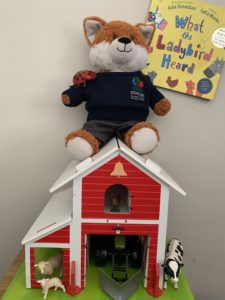
We’re sure that you’ll all be familiar with this story; you might even have a copy at home. It’s called ‘What the Ladybird Heard’ and is written by Julia Donaldson. At Nursery, we always join in with the animal sounds, just like we did in Friday’s story.
- Which part of the story did you enjoy the most?
- How did the animals trick Hefty Hugh and Lanky Len?
- Which is your favourite farm animal?
We think you’ll also enjoy this version where Julia Donaldson tells the same story through a song.
Here are some activities that you can try that are linked to the story.
Creative – Can you make a farm yard? You could use Duplo or Lego to make a farm house or barn for your toy animals and tractors. If you have a tray with sides or an empty (storage) box with low sides you could make your own farm small world area. At Nursery, we often add Weetabix and other dry cereals to use as animal food. It can be a little bit messy but hoovers up easily at the end of the day!
You could make a little ladybird and use it re-tell the story as it flies from one animal to the next.
Mark making – Can you draw some of the animals that they found on the farm? Maybe you could draw a map of the farm like Hefty Hugh and Lanky Len used. You could even draw a long wavy line to show where the ladybird flew.
Listening games – Listen closely to the story. What does the ladybird hear? There is a ladybird on every page and he/she hears all the goings on in the farmyard and story. Play your own game, listening to the world around you. Say the phrase “I hear with my little ear something that sounds like…” Describe that you can hear around you.
Here’s a game we sometimes we play at Nursery. Get your listening ears ready… What animal can you hear? One of the cats purring is a little bit tricky!
Find out more about ladybirds – Here’s a short video all about ladybirds. Can you spot any ladybirds in your garden or on a walk?
In our Nursery garden, we often find ladybird larvae on the leaves of our willow arch at this time of year. It’s one of the stages in the lifecycle of a ladybird. Have a look on leaves and see if you can spot any the larvae (the spiky black and orange insect) or pupae over the next few weeks.
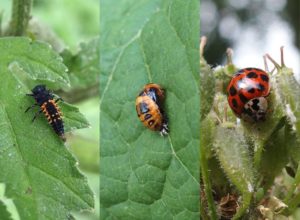
Photo taken from https://www.flickr.com/photos/nickwood-photos/34936434334
Mathematics
1) One of the mathematical concepts that children sometimes find difficult is knowing that they can split a group of objects in different ways, but that the total is still the same. Here is an activity that may help with this.
Draw a ladybird outline and cut out 4-6 spots. Start with 4 spots and count them together with your child. Ask them to put the spots on the ladybird’s wings. How many are there? Talk about how many spots there are on each wing, but that there are still 4 spots altogether. Repeat, splitting the spots in a different way (Eg 2 spots on each wing, or 3 spots on 1 wing and 1 spot on the other). Each time you move the spots, count how many there are on each wing and how many there are altogether. That’s right, there are still 4!
If you return to play again another day, repeat the activity using a different number of spots between 2-6.
2) If you fancy painting, draw some basic ladybird outlines and ask your child to paint or fingerprint a given number (e.g 1-5) of spots on each wing. How many spots are there on both wings? Which ladybird as the fewest/most spots?
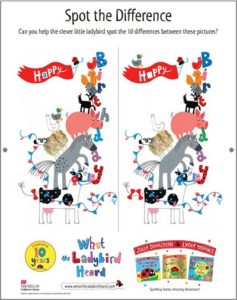
Can you spot the difference? – Look carefully at the picture and see if you can find all of the differences.

Watch – If you’ve missed being able to visit farms, Temple Newsam have some video blogs with Farmer Joe. They give you a little insight into all of the work that is going on at Home Farm during lockdown and you can see (and hear) the animals too!
We hope that you enjoy joining in with some of this week’s learning activities. Let us know which you enjoy. Have fun!