
20 March 2020
This week, the whole school has the same Talk Time homework: I can pay and receive compliments to/from people outside of school.
This homework, which links to our recent living and learning statement, is an opportunity for children to discuss the benefits of paying compliments to people. Here are some questions that might shape your discussion:
- How does paying a compliment make you feel?
- How does receiving a compliment make you feel?
- Why is it important to be sensible when paying or receiving compliments?
- Can you compliment people too much?
- Is it ok to compliment a stranger? Is this safe?
Children should be ready to discuss what they’ve talked about at home by Thursday 26 March 2020. It would be even better if children were able to talk confidently about times when they have given, or received, a compliment.
13 March 2020
Our homework this week is Creative: I can show my talents.
All of the children in our school are blessed with an array of talents. This week, our homework, which links to our living and learning statement (I can recognise my talents), gives our children the opportunity to celebrate and share their talents. Children should respond creatively and be ready to show off their talents to their peers as part of their homework review. They could do this in a range of ways:
- create a short performance to show to the class
- film themselves showing off their talent
- make a collage of their many talents
- produce a piece of art to show off their talents
There are, of course, many other ways that children could respond. Children should be ready to show off their talents by Thursday 19 March 2020.
06 March 2020
This week’s homework is a Talk Time homework and is linked to our current history topic. We would like you to talk to your child about your favourite toy as a child. There are some starting questions below.
- What was it called?
- What did it do/how did you play with it?
- What was it made of?
If you could make a few notes for your child, find a picture of you with it or are able to show us it (if you have still got it!), it would really help our discussions.
If they could do the same with a grandparent as well, that would be fantastic!
28 February 2020
This week, our homework is Creative and is helping us to celebrate World Book Day next week.
I can show what I love about reading.
Children could come up with their own ideas for how to show this, or ideas might include:
- create a labelled diagram of the perfect place to read in
- write a book review
- draw and label/describe a character from your favourite book
- write a letter to an author telling them how much you loved reading their book
- write a one minute speech on your favourite book, persuading others to read it – consider what the most exciting parts are, which characters you love or you love to hate, who might enjoy reading it next and why
Be as creative as you like.
This homework will be celebrated in our weekly homework review on World Book Day itself, 5 March 2020.
07 February 2020
This week, the whole school has the same creative homework, which is due in on Thursday 13 February 2020.
I can show different ways to stay safe, including online.
This week, linked to our Living & Learning, we have been thinking about how to make safe choices, including online. There are many ways, and many different situations, in which we need to keep safe: at home, at school, in our environment and online.
Children should think about the situations where they need to keep safe and who might help them to stay safe. This could be done in any creative way:
- A story
- A poem
- Instructions
- A comic strip
- An advert
- An interview
- A game
- Scenarios
…or any other creative ideas!
The homework will be reviewed as part of our weekly homework review.
31 January 2020
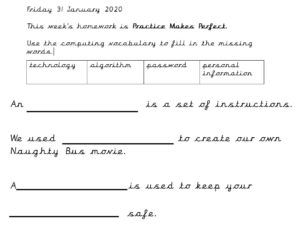
This week, our homework is Practice Makes Perfect: I can try out Times Tables Rockstars.
Recently, we have purchased a subscription to an online platform that enables children to learn, or practise, times tables in a fun, engaging way. On Times Tables Rockstars (TTR), children can challenge their friends or earn coins to work their way up the school leader board. Many children have already been on TTR outside of school time, but this homework is a way of encouraging everyone to have a go. This week, we’d like all children to spend some time (how much is up to them) playing on the game – therefore, practising their times tables. Each child has been given their log in details. If you have any problems logging in, please let us know. Similarly, if for whatever reason accessing TTR is not possible, please do not hesitate to come into school and we will arrange an alternative.
31 January 2020
24 January 2020
This week, the whole school has the same Talk Time homework: What is a drug?
This homework, which links to our Living and Learning statement, is a first step in children becoming aware of drugs. There are a few key points you may wish to talk about at home. Children need to be aware that some drugs are helpful, some are harmful, some are legal, some are illegal. Don’t forget to consider that even the legal or helpful ones can be harmful.
Below are some question prompts that could help shape your discussion…
- What is a good definition for a drug?
- What is a drug? What is not a drug?
- Are all drugs bad?
- Why might some people need to take medicines?
- Who can prescribe medicine?
- Who should administer medicine?
- What should you do if you find some medicine?
- Should you take medicine that isn’t yours?
Children should be prepared to discuss what they’ve talked about at home during our homework review next week. This homework should be completed by Thursday 30 January.
17 January 2020
This week, the whole school has the same Creative homework:
I can show different ways to make things better.
This homework, which is due on Thursday 24 January, is an opportunity for children to reflect on our living & learning statement for this week: I can make things better.
Children should think about ways to make things better in a variety of different situations and contexts:
- in class
- in a friendship group
- at playtimes
- at home
- with siblings
- out and about (countryside, park)
- the wider environment (recycling)
You could consider…
- Why should we try and make things better?
- How do we do this?
- When should we apologise?
- What is the effect it has on others around us when we make things better?
- Older children might want to consider the benefits of restorative justice.
Don’t forget to be creative! Produce a report or diary; capture photos of making things better; create rules for better games at play times; make a poster about how to say sorry; or, think of your own creative response.
This homework will be celebrated in our weekly homework review.
10 January 2020
This week, our homework is Practice Makes Perfect: I can use computing vocabulary. This half-term, we’re becoming computer programmers during our computing topic. In the world of computing, there are many words that sound really complicated but actually are just a fancy way of saying something we already know. This week, for their homework, children should use the vocab sheet they’ve been given to learn the words and their definitions (there’s a short task to complete on the sheet, too). If you have any questions, please do not hesitate to speak to your class teacher.
Children should have completed the task, and more importantly learnt the words, by Thursday 16 January 2020.
This week, our homework is Practice Makes Perfect: I can use computing vocabulary. This half-term, we’re becoming computer programmers during our computing topic. In the world of computing, there are many words that sound really complicated but actually are just a fancy way of saying something we already know. This week, for their homework, children should use the vocab sheet they’ve been given to learn the words and their definitions (there’s a short task to complete on the sheet, too). If you have any questions, please do not hesitate to speak to your class teacher.
Your child has a paper copy of the vocab and the definitions – this is also below.
An algorithm is a set of instructions written for a computer to achieve a certain goal.
It’s like making a cake. The instructions need to be clear so that you don’t put whole eggs into a bowl – shells taste awful! It’s the same as a computer: if you’re not precise enough, the BeeBot might fall off the table or your game in Scratch might never end and you’d still be playing it when you’re old and wrinkly!
A variable is a feature that keeps track of changes in a program.
It might vary! It could be a health bar, a points system or a timer. In Scratch, for example, it might make the program more difficult but it’s definitely more entertaining!
Decomposition simply means to break down a problem into smaller steps.
Think of decomposition as breaking down a task into smaller steps or tasks. For example, imagine there’s something that you really want someone to buy you. First, you’ve got to plan what you’re going to say and how. Then, you’ve got to practise your puppy dog eyes in the mirror. Finally, you’ve got to prepare for their reasons why you can’t have it so you’re ready with what to say next. That’s just like Kodu – you’ve got to design and create the maze, design and create the main character and program any other features you’d like.
A simulation is a way we can replicate (copy) real-life situations in a computer to see how they’d play out.
Imagine you’re planning a holiday to Mars. Would you just pack your bags and head to the local rocket launch pad? NO! You’d first set up a simulation of how the rocket would be effected in that kind of situation to ensure that we can get there and back safely. At school, we could link our simulation learning to setting up an animation of the water cycle or maybe to show how the moon orbits the Earth.
Sequence and selection is how we tell a computer what to do and when.
Think of it like sequence meaning the order something happens in and selection is the algorithm choosing which path to take. It’s easier to think of the words “If… Then…”. For example:
If I dance in the rain… Then my hair will get wet.
If I dance in the rain and I have an umbrella… Then my hair will stay dry.
If I poke the cat hard… Then it’s going to bite me.
You get the idea.
Your digital footprint is the mark you make on the internet.
You must think carefully about what you post online as it is difficult to remove it once it’s out there. This could potentially have damaging consequences to your future. Do you want to be rejected from a job interview in ten years because you kept posting videos of you singing “I Will Always Love You” to your pet whilst bouncing on your trampoline wearing a shower cap? Didn’t think so. Each to their own, you know, but just be really, really careful about what you post, OK?
Content is anything that exists digitally.
Digital content is anything stored as digital data. This could include information that is broadcast online, anything that is streamed or contained in computer files. Or, for you whippersnappers, it could be classed as memes, ‘How to guides’ or any of your favourite YouTube channels. Digital content is pretty much what it says on the tin – anything contained online or on a computer.
Disinformation is when someone deliberately shares false information to trick other people.
Say a chicken farmer is losing money to their rival who is an avocado grower. They might start false rumours (also known as hoaxes) on the internet that avocados can turn your feet bright green. This is done on purpose to make people think and act in a certain way which in this case would be to stop buying avocados so they can start buying chickens again. This section is a buy one get one free because misinformation is where someone shares false information by accident, like the people who shared articles about mouldy green feet in this story. Sadly, sometimes it’s really difficult to tell which information is FAKE NEWS and which is actually genuine.
Phishing is when someone sends you an email or message pretending to be someone else to find out your personal information (eg. password, address, bank details, etc.)
Think of it like they’re fishing for your information by pretending to be a company you trust. These scammers may send an email or message with a link attached that tricks you into giving up your personal information like passwords, images or bank details. You should never click on anything or respond to anyone you don’t trust. Check the email address, the trustworthiness of the website or contact the company directly. Remember: if something’s too good to be true, it probably is.
Now, cover up the information above and put our computing vocab into the table below (from memory if you can!).
| is the mark you make on the internet which can be really difficult to remove. | |
| is anything that exists digitally. | |
| is when someone sends you an email trying to gain access to your personal information. | |
| is a set of instructions for a computer. | |
| is how we tell a computer what to do and when. | |
| is false information that is shared on purpose to try and trick people.
(_________________ means they shared it by accident.) |
|
| is when a complex problem is broken down into smaller steps. | |
| is a way for us to replicate situations in a computer to see how they’d play out. | |
| is something that changes in a game (or other program) like lives, a timer or points. |