
Lost and Found
We began our learning this week by looking at the story Lost and Found. This will be our focus story for the next two weeks.
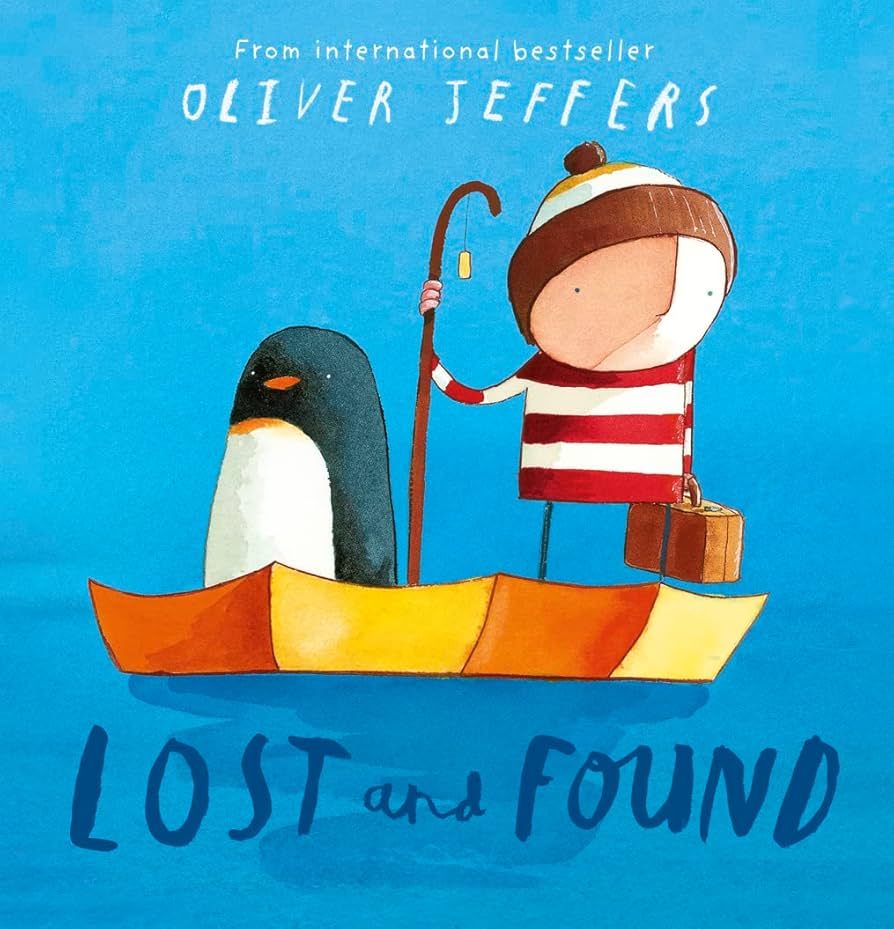
In the story, a boy finds a penguin at his door and goes on an adventure to try to find his home, as he thought he was lost.
Just like the boy, we explored and learnt about where penguins live and extended our vocabulary by learning a new word: iceberg.
It’s ice in the water. Violet
A big chunk of ice. Frankie
It’s a big thing of ice that goes under the sea. It can ruin a ship. Kitson
It was wonderful to hear children using this new vocabulary in our small world area.
Let’s make the penguins dive off the iceberg!
This penguin is swimming around the gigantic iceberg.
Using props, we were able to retell the story.

Phonics
We have begun learning our Phase 3 sounds. This week, we have learnt four new digraphs/trigraphs ai,ee,igh,oa.

Poetry Picnic
Each week we will be learning a new poem. We will recite this poem each day. By saying the poem out loud, we can focus on the sounds and rhythm of each word or line. We talk to the children about how this can help us become better readers. This week’s poem is called Let’s Put on Our Mittens.
Click here to listen to Reception recite the poem.
Music
Our song this week was We are Family by Sister Sledge.
This was very popular as lots of children had heard the song before when watching the film Trolls.
The nursery rhyme was Wind the Bobbin Up. As the children knew this one very well, they were able to perform confidently!
Check out our other learning

Dates
Tuesday 16 January 9- 10 Stay and learn
Our Stay and Learn sessions are a chance to find out more about your child’s journey through Reception. You can observe some teaching and learning, and pick up some tips to support your child at home.

Science
We are being chemists this half term. We are investigating different materials and their properties. The children were introduced to their new vocabulary which they will be learning. 
We investigated which materials were electrical conductors and insulators. The children made circuits and inserted different materials to see if they let electricity flow through them – if they did, they were a conductor. we were ably to use the skill of comparing, classifying, grouping and predicting.


Help at home: Can you help your child learn the new vocabulary?
HAPPY NEW YEAR!
Happy New Year! Welcome back everyone! We hope you’ve had a lovely, restful break and that you’re full of energy for another busy and exciting half term at school.
A New Topic For Key Stage One.
This half term is all about History and we will be looking at how shopping has changed for people over time. We will be looking at Briggate High Street and we have an exciting trip to Abbey House booked to support our learning in school.


Our new Topic was kicked off this week by thinking about the past and by introducing timelines. We thought about the things that have happened in our past and thought about the order in which they happened. In groups, we sequenced events from our own lives and discovered that a timeline can be different for different people depending on the order things happen to individual people.


Help at home: by talking about the past and the present. You could talk about your childhood and how it may be similar or different to now. What was your house like? Which TV programs did you watch? What kind of toys did you play with? What kinds of foods did you eat? Can you compare the things that are in your child’s living memory, your living memory or even the living memory of the oldest generation in your family?
Happy New Year!
Happy New Year and welcome back to Nursery! We hope that you all had a great Christmas and enjoyed a break over the festive period. It was lovely to see everyone on Monday morning and hear about your holiday adventures and presents from Santa.
This week, we’re reading ‘The Gingerbread Man’ and children are already beginning to retell the story in our small world area. If you have a copy of the story at home, please enjoy reading it together. If not, you might like to listen to Mr Tumble reading it.
Children love to join in with the repeated refrains in the story. Can they remember what the Gingerbread man shouts? “Run, run, as fast as you can, you can’t catch me, I’m the Gingerbread Man.”


So far this week, we’ve made Gingerbread Men in the playdough area, counted buttons on his tummy and we’ve loved getting messy in the gingery cornflour gloop!


This week’s letter is ‘m’ for mouse. We pronounce it as ‘mmmmm’.
Help at home: In group time, our sound bag had lots of ‘m’ objects including a marble, a mouse, a map and a mirror. What can you find around the house that begins with the ‘m’ sound? What other ‘m’ objects could we have put in our sound bag?
Nursery rhyme of the week: Pat-a-cake
Pat a cake, pat a cake, Baker’s man. Bake me a cake as fast as you can. Pat it and roll it and mark it with B. Put it in the oven for baby and me.
There are lots of different versions of this rhyme, here are two from CBeebies if you would like to sing along at home. CoComelon The Baby Club

It’s been a cold start to the week so children decided to make a ‘fire’ and loved toasting marshmallows on the sticks that they collected. Just as a reminder – we play out in ALL weathers at Nursery and at this time of the year, it can be very cold. Please make sure that your child has a warm coat, a hat and some gloves to wear to help keep them warm and happy whilst we play. Please write their name in them too as it’s really helpful when we’re trying to find who they belong to. Thank you in advance.
You may have noticed some new faces in Nursery this week or heard your child talking about some new Nursery members of staff. We’d like to welcome Mrs Gall, Miss Swift and Miss Bennett to our Nursery team.
Next week – 15 January 2024
We look forward to welcoming some new families and children to Nursery for their first sessions on Monday 15 January. Our new ‘yellow group’ children will join red group as they come into Nursery through the main door each morning so it may feel a little bit busier than usual. Please be patient as we help to settle the new children into Nursery. We’re looking forward to getting to know everybody and making some new friends.
Story – Little Red Riding Hood
Letter next week – ‘d’ for duck
Nursery rhyme next week – The Grand Old Duke of York
Living and learning: I know what a drug is
Our living and learning statement this week has allowed the children to explore the idea of peer pressure. They began by discussing the influences that might make someone try drugs such as social media and friends. They ranked them in order of the biggest influence. We discussed strategies that could get the children out of a situation where they felt pressured. These included coming up with an excuse and leaving the situation or being more assertive and explaining why they don’t want to try something.
Help at home: How confident does your child feel about resisting peer pressure? Ask them what strategies they’d use.
New member of staff in 1,2B
We said goodbye to Mr Goodwin before Christmas but we’re now saying Hello to Miss Gilliland, who will be with us until July

It’s beginning to look a lot like Christmas…
This week, we’ve been learning about the story of the first Christmas- The Nativity. We know that this story is why Christians celebrate Christmas.
We re-told the story with actions. This helped us to remember key people and events.

Christmas around the world
We’ve been exploring the different ways that people celebrate Christmas around the world. We looked at the difference between Santa in the UK and Santa in Australia.

Did you know that when Santa gets to Australia, the reindeer are given a rest whilst the six white boomers (kangaroos) take over pulling Santa’s sleigh?!
We made Chinese paper lanterns for decorations.


We read about the good witch, La Befana, who brings presents to children in Italy.

Ask your child if they remember the story of La Befana and who she helped that were on their way to see the baby Jesus.
We made observational drawings of Poinsettia- a popular Christmas plant here, in Mexico and in India.
We went hunting for the lucky almond (in picture form). In Denmark, it’s a Christmas tradition to hide an almond in rice pudding. The finder has good luck for the year!

On Friday, we drew presents and sweets onto a picture of shoes. In the Netherlands, Sinterklaas leaves gifts in children’s shoes, that the children fill with straw and sugar for his horse.
Our shoes were magic and turned into real treats at party time!

Christmas performance
Wow! How amazing were our performers this week?! Well done to all of the children who have been working so hard and who were so brave up on that big stage. Thank you to the parents and carers who joined us and provided such fabulous costumes. We hope you enjoyed our Christmas production!
A very special visitor
On Wednesday, we received a very special video… Santa had been to visit our school. We were AMAZED that he had managed to hide our presents in the classroom. What a special treat!

Professor Myers and The Candy Cane Experiment
On Thursday, we were visited for the first time by Mrs Myers twin, Professor Myers! Professor Myers is a science expert and often shares amazing experiments with us in Reception. We tested the strength of a candy cane, experimenting with objects of different weights to see how much the candy cane could hold before snapping (the box of rocks was the heaviest!)

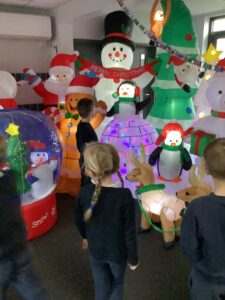
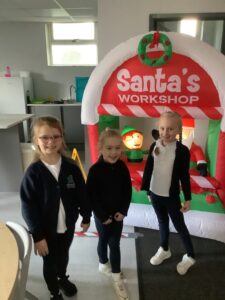
A Christmas inflatable wonderland and Christmas dinner
Thank you to Mrs Pennock, who treated us to her inflatable Christmas Wonderland on Thursday!
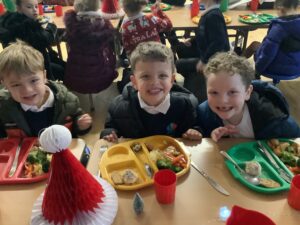
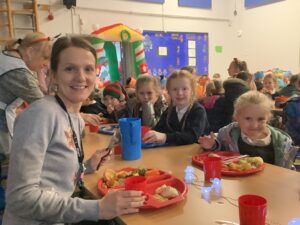
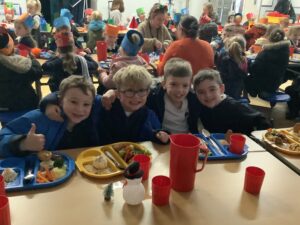
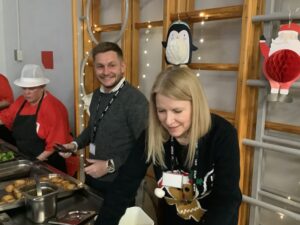
Afterwards, we enjoyed our yummy Christmas dinner. Thank you to all of the dinner staff (and Miss Hague and Mr Catherall) for cooking and serving our special lunch.

We had so much fun at our Christmas party…

Take a look at our classroom activities this week

A Christmas message from Reception

MERRY CHRISTMAS AND HAPPY NEW YEAR FROM KEY STAGE 1
We would like to wish all our families a very Merry Christmas and Happy New Year from all the staff in Key Stage 1. We’re also wishing Mr Goodwin good luck on his next placement at one of our sister schools. We will miss him!

Christmas lunch
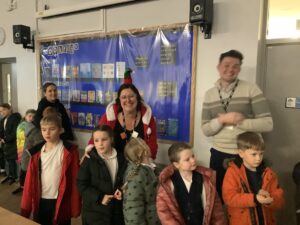
We had a lovely lunchtime yesterday. We visited the ‘Mrs Pennock inflatable display Christmas grotto’ and then had a lovely Christmas lunch together in the hall!
Exhibiting our sculptures
This half term, we have created our own sculptures inspired by Barbara Hepworth’s The Family of Man (1970) – a sculpture we saw on our trip to the Yorkshire Sculpture Park.
https://ysp.org.uk/art-outdoors/the-family-of-man


We were able to mix colour effectively to create the effect of patina found on The Family of Man (this is the green or brown colour created on bronze and other metals after weathering over time).
We were inspired by her use of negative space and included this in our artwork, too!
Help at home: See if your child can remember the following pieces of vocabulary from our topic and what they mean: negative space, sculpture, modern art and classical art.