
The Train Ride
We finished last term with a very exciting week focused on learning how to stay safe. The children took responsibility for keeping our outdoor area safe by carrying out their own daily safety checks and placing cones around any areas they identified as unsafe. They practised crossing the road safely using our very own zebra crossing and discussed how to stay safe near water during visits to the park. To round off the week, we were delighted to welcome a fire engine and its crew for a special visit. What a fantastic week of learning and fun!

This term promises to be just as exciting as we approach the end of our Nursery year. We will begin our learning with a book about a train ride, which will inspire lots of discussion.
Book of the Fortnight

The Train Ride by June Crebbin
Through this story, we will be thinking about journeys we have been on and sharing our own experiences. In the construction area, the children will have opportunities to design and build their own vehicles. We will also be investigating forces by creating tracks and ramps, exploring how objects move and finding out what makes them go faster or slower.
Phonics
Over the next few weeks, the Red, Blue and Yellow groups will be focusing on oral segmenting and blending skills during group time. This is when we break words down into individual sounds and learn how to blend them together.
Oral segmenting and blending is an important skill for children to acquire before they begin the more formal teaching of phonics in Reception. We practise segmenting and blending the sounds we can hear in words; we do not expect children to recognise, read or write letters in Nursery.
This skill can be quite challenging and may take some time for children to master. It will continue to be taught throughout the Foundation Stage.
For example, to segment the word bus, we would say:
b – u – s
We always use pure sounds and try to avoid putting an “uh” sound on the end of a letter sound. For example, we say “ssss” rather than “suh”.
If you would like any support with helping your child practise these skills at home, please speak to a member of the Nursery team.
Nursery Rhyme of the Week

In Maths, we are learning about day and night and discussing the differences between them. The children will be exploring what happens at different times of the day and thinking about the activities they do in the morning, afternoon and evening.
Next week, we will move on to ordering key events in our daily routines, helping children to develop their understanding of time and sequence.
Help at Home
Talk to your child about day and night. What activities do people do during the day and at night? Can they talk about what they do in the morning, afternoon and evening? Looking at family routines together and discussing the order of daily events is a great way to reinforce this learning.
Reminders
As the weather becomes warmer, please refer to our guidance regarding sun cream. Please ensure that your child comes to Nursery each day with a named sunhat and water bottle so that they can stay safe, hydrated and comfortable while enjoying outdoor learning.
Thank you for your continued support. If you have any questions about your child’s learning, please speak to a member of the Nursery team.
Staying Safe
This week, we took part in Safety Week and spent time learning about how to keep ourselves and others safe in different situations.

The children enjoyed spotting potential dangers around the home, including hazards in the kitchen and living room such as trailing wires, hot pans, candles, fires and sharp objects. We discussed why these can be dangerous and how to stay safe around them.
We also played a fun safety game where the children moved forwards if a scenario was safe and froze and shouted “Stop!” if they thought it was unsafe. Some of the scenarios included wearing a helmet whilst riding a bike, stroking a dog that runs up to you in the park, jumping into a river on a hot day and remembering to wear sun cream.
In school, the children explored how we can stay safe in our classroom and outdoor areas. They identified possible hazards and created colourful safety posters with captions to share their ideas.
We also talked about the important adults who help to keep us safe, as well as the ways children can help to look after and support each other.
To finish the week, we watched a road safety video and discussed different types of road crossings and how to cross roads safely.
The children showed a great understanding of how to make safe choices in everyday situations.
Our special visitors included D.side who talked about how to keep healthy, some firefighters showed us their equipment and catering Leeds came to talk to us about germs and keeping our hands clean.


Help at Home: Talk to children about staying with a grown up and waiting agt every kerb to cross the road. We have also been looking at how to keep healthy, can they share 3 ways to keep happy and healthy?

We released our butterflies today, all 10 of our butterflies made it, and flew off to continue their lifecycles.

Water Safety
Martin from the Canal and River Trust came to educate us about staying safe near water today. One of the main points he said was that swimming in a pool is best. Canals can be full of animal excretion that can lead to diseases.
Martin told us that we should never follow a friend into the water if they are struggling. Instead, we should call the emergency services to come. Whilst waiting for the fire brigade we could throw in a ball or an empty water bottle. These could help to keep our friend buoyant until help arrives. We might also look for a nearby life ring that we could throw into the water.
Even though you might be a strong swimmer you should always wear a life vest when participating in boating or water sports. If you bump your head and become unconscious, the life vest would save you from drowning.
The main message today was: ‘STAY AWAY FROM THE EDGE’ when near open water.
Have a very safe half term holiday!


Living and Learning : Staying Safe week in 1,2B
We’ve had a busy week learning all about how to stay safe. We’ve learned about saying safe online, at home, near the roads, near water, in the sun and out in the community. Buddy, from the NSPCC, taught us to ‘Speak out, stay safe.’
Help at home by helping your child learn to say their full name and address or telephone number.


Staying safe themed week – 1A
We have enjoyed learning all about staying safe this week. We have had visitors like fire fighters, police, water safety visitors and D-side.


We have also been learning lots about staying safe in class. We talked about being safe
- in ths sun
- online
- in school
- near traffic
- around dogs
We also discussed how each person’s body belongs to them and how to respect others.


Well done everybody for super listening and joining in all week!
Have a lovely, and safe half-term break!
Living and Learning – Staying Safe Week
This week has been one of our Living and Learning themed weeks – STAYING SAFE WEEK.
- Being Safe
We’ve been learning about what is appropriate and what is not using Rachel Brian’s book ‘Respect: Consent, Boundaries and Being in Charge of YOU’.
We’ve also thought about boundaries when negotiating about space and objects. We’ve discussed about it not always being right to keep a secret if it relates to being safe. If something doesn’t feel right, in person or online, with someone we do or don’t know, we’ve talked about how we should Start Telling Other People (STOP.)
- Health protection and prevention
We’ve been learning about safe and unsafe exposure to the sun and how to reduce the risk of sun damage including skin cancer. We’ve completed some basic First Aid training to empower us to act calmly and effectively in emergencies. We’ve had a very engaging drug education session with d:side about the effects of smoking.
- Personal safety
- The Canal and River Trust led an interactive assembly all about water safety.
Louise Crossland (our PCSO) spoke to us about how to stay safe near roads, near water and at the park.
We’ve learned about hazards that may cause harm, injury or risk around water, on the road, with food and in the home. We’ve thought of ways to reduce these risks.
Help at home by asking your child to discuss their learning this week.


Year 3,4 Book Club
Last week during Book Club, 3,4C explored our class novel, ‘The Miraculous Journey Of Edward Tulane’ through drama. We explored:
- the story so far
- how Edward has changed as a character since the beginning of the story
- how different characters have felt at different points during the story
Help at home by asking your child to retell the story so far and explain how Edward has changed as a character.


Year 1 Maths
Year 1 have been busy this week, measuring things in and around the classroom.
We began our learning with measuring using non-standard units such as cubes.


‘Length is how long something is, from start to finish.’
‘Height is how tall something is, from the bottom to the top.’
We also used centimetres to measure small objects in our classrooms.
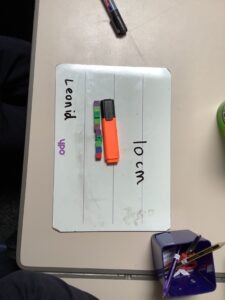


After this, we used rulers to measure objects accurately.

We need to line the object up with the end of the ruler, keep it straight and measure to the closest centimetre.
Help at home by making good estimations about how many centimetres long or tall, household objects are.
Staying Safe Week – first aid
As part of Staying Safe Week, Year 5 and 6 have been having some first aid training. Darren visited each class to inform the children of some simple but effective first aid. He began by making sure the children who knew to call in case of an emergency. The children were able to talk about 999 and all the emergency services they could contact.
They moved onto some simple techniques that the children could rely on if someone is feeling unwell, such as sitting backwards on a chair to help someone suffering from breathing difficulties. The classes engaged so well in the discussions and practical work.
Living and Learning : Staying Safe themed week
This week, we’re learning all about staying safe and keeping ourselves safe.
There will be visitors and a change in lessons to cover all the areas below.
Help at home by talking to your child about risks and how they can stay safe at home, in the car and out in the community.
