Living and Learning: Democracy
Over the last three weeks, in Living and Learning, we have been focussing on the British Values.
Democracy
Individual Liberty
Respect and Tolerance
Rule of Law
Each week, we have focussed on a different British value.
To start, we looked at Democracy.
Democracy means power to the people and comes from the Ancient Greeks, who invented democracy. Demos = people and kratos = power or rule.
We learnt about what democracy looks like in the UK and what happens in our school that relates to it: the JLT elections, voting for something in class etc.
Help at home: Ask your child to think what our country would be like if we weren’t in a democracy.
Welcome to Nursery
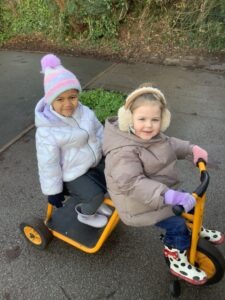
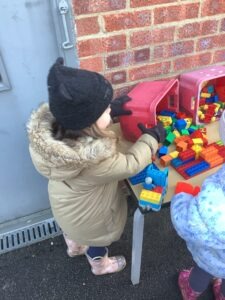
We have had a busy week settling green group into Nursery and helping them to explore their new environment. They’re all doing really well and are gradually getting to know us and beginning to make some new friends. Some of the children have already stayed for lunch and next week will stay for their first full day, what a fantastic start!
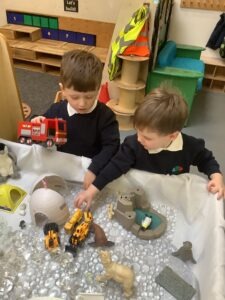
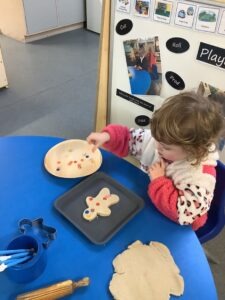
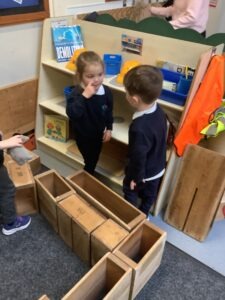
This week, in Maths, we have been representing numbers in lots of different ways with our fingers, on a five frame and with marks. We have been counting carefully and finding out about the “stop” number. The concept that the final number counted is the total number of items in a group.
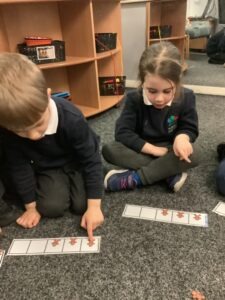
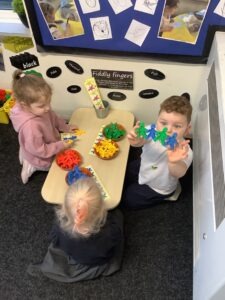
We’ve also explored different shapes. Noticing which shapes had straight or curved sides and how many corners each shape had.
We also discovered a new word “transparent”. We used it when we looked through the ice last week and this week we found that lots of our shapes were transparent too.
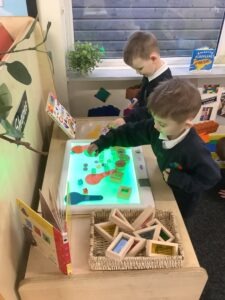
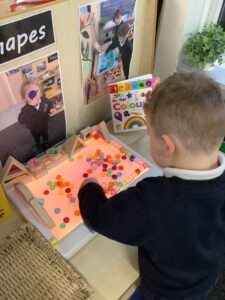
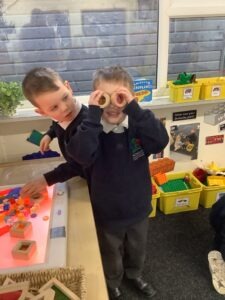
Next week we will start some new learning about weight. We will be using words such as heavy, light, heavier and lighter to compare different objects.
Help at home: You could continue this learning at home by asking questions during everyday activities. Which bag from the supermarket is heaviest/ lightest? Which toy is lighter? Can you find something that is lighter than the bottle of milk? Can you find something that is heavier than a packet of crisps?
Next week’s learning
Sound next week
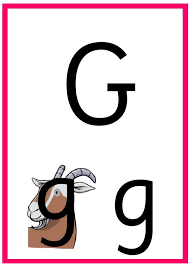
Nursery rhyme of the week
Story of the week
Little Red Riding Hood
Reminders
Things your child needs every day in nursery..
- A water bottle.
- A warm coat, hat and gloves – we play outside every day.
- A change a clothes in a bag.
Science-Plants and Animals
Our strand of Science is Biology-we are learning about living things. In week 1 we looked at the parts of a plant. We can identify the: root, stem, leaf and flower. We have planted some bulbs and put them on our classroom windowsills. We’re hoping they grow well!
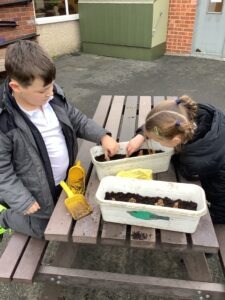
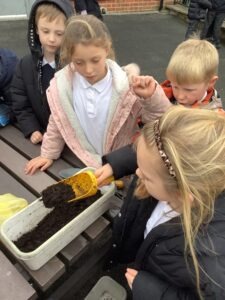
This week we have begun learning about animals. In particular-mammals.
Mammals have fur or hair. They have live young and they are warm blooded.- Norah
Using this definition, we have been sorting animals into ‘mammals’ and ‘not mammals.’
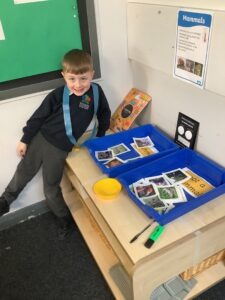
Check out the BBC Bitesize pages about Mammals-we love them!
Help at home: Can you talk about the different parts of a plant? Perhaps you can compare different plants when outside. When you come across an animal: discuss if it a mammal or not and why.
Lost and Found
This week, we’ve continued to enjoy the story Lost and Found by Oliver Jeffers and have been making lots of connections between the book and our topic learning.

We explored a world map and located England and Antarctica, before tracing the journey the boy and the penguin would take from where we live in the UK all the way to the South Pole. We revisited what we already know about maps, with some children remembering that blue shows oceans and green shows land. Others also spotted the orange and brown areas and suggested these might be deserts.
We also compared our weather with the weather in Antarctica and talked about how different it is. Our word of the week is climate and we’ve been using it to describe what the weather is usually like in different places.
Penguin observations
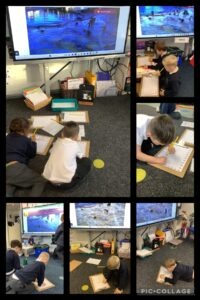
Children loved being zoologists this week. They enjoyed observing a live stream of the penguins at Edinburgh Zoo and wrote about how the penguins move and interact with one another.
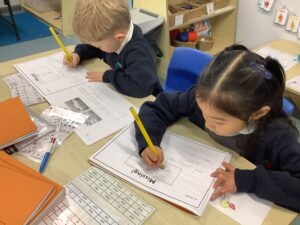
In writing, we created ‘Missing’ posters, carefully describing the penguin from the story and thinking about the key details someone would need to help find him.
Maths; the staircase pattern
In Maths, we’ve been looking at counting and ordinality- specifically, the ‘one more’ relationship that creates ‘the staircase pattern’.

We were introduced to the concept by watching an episode of the Numberblocks, before moving on to create our own staircase patterns.
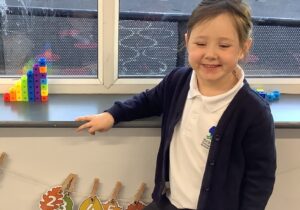
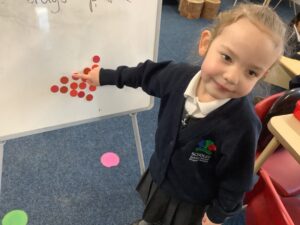
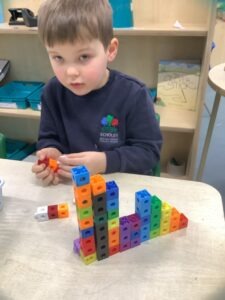
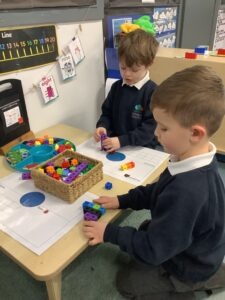
We even overheard some of the children singing the Numberblocks song, “I’m bigger than you. I’m smaller than you. Diddly diddly doo!” as they ordered their towers into the staircase pattern.
Phonics
This week, our phonics learning focused on the digraphs oo, ar and or.
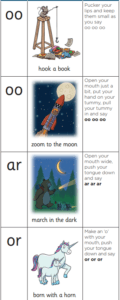
We also learned the tricky words was, you and they. Tricky words are read by sight, as they cannot be sounded out easily.
Help at home – Tricky Words
Here’s a simple game for you to play at home to support reading.
Tricky Word Bingo.
- Enter your chosen tricky words into an online picker (such as pickerwheel.com) or write them on paper to choose from at random.
- Ask your child to select 4–6 tricky words and write them down. You can join in too, or invite a sibling to play.
- Take turns choosing words.
- The first person to cross off all their words and shout BINGO wins!


Poetry Basket
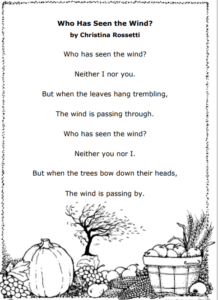
Each week, we learn a new poem and recite it daily. Saying the poem aloud helps the children focus on the sounds and rhythm of each word and line, supporting their reading development. This week’s poem is Who Has Seen the Wind?
Swimming
Rainbow class made a splash in their first swimming session this week, with lots of happy faces and plenty of laughter as they splashed in the pool! They followed instructions carefully to enter and exit the pool safely and took part in games using pool noodles and floating toys to help build their confidence in the water.
We’re sure that Sunshine class are looking forward to their first lesson next week. They’ll need their kit on Wednesday.
Help at home – Self-help skills
To help make swimming days run smoothly, please make sure all clothing is clearly labelled. You can also support your child further at home by encouraging them to practise getting dressed independently. It’d be especially helpful for children to practise turning their clothes the right way around (such as trouser legs and sleeves) to help them be as independent as they can be when getting dressed after their lesson.
Penguins, paints and pipettes!
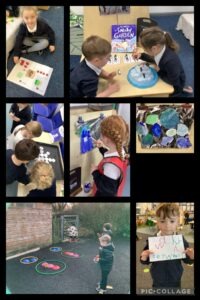
And finally, here are a few more photos from our learning this week. We’ve been improving our fine motor skills by balancing penguins and squeezing pipettes, practising our throwing skills, experimenting with paints on different media and designing our own certificates.
We are Historians
This half term our Topic is History. We are learning all about toys from the past.
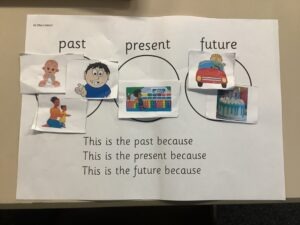
First we learnt about timelines. We learnt that some things happened a very long time ago. The past means something has already happened. This could be 5 years ago or 5 minutes ago. We ordered events from our lives using a timeline. Some of our timelines looked a bit different to others!
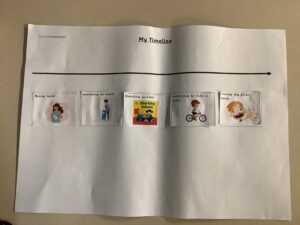
Some children have already lost a tooth whereas others have not lost one yet. Some children have learnt to ride a bike, others have not yet learnt.
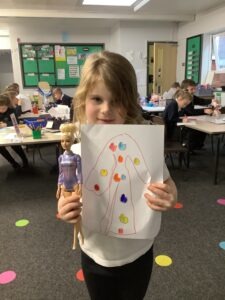
We also brought our favourite toys into school. We had so much fun playing with them and explaining why we love them so much.
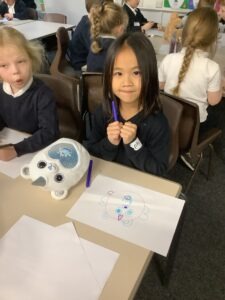
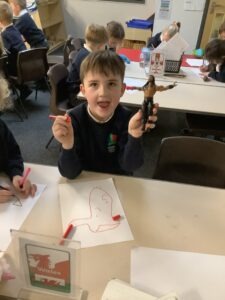
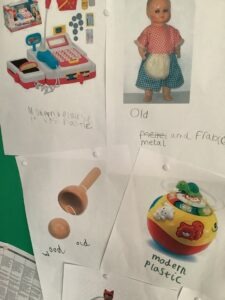
Each class has also been looking at toys from the past. We know some toys look older than others because of the materials they were made from or their condition. Some toys look dusty, rusty and full of scratches whereas others look shiny, colourful and in better condition.
Class novel crazy!
We are still continuing to enjoy our class novel – Viking Boy by Tony Bradman.
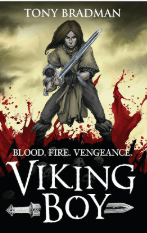
The story follows a young Viking boy who navigates through some emotional and difficult challenges. The children are really engrossed so far and we are definitely invested in Gunnar’s fate. After each chapter, we add to our story maps where we write a 5 word summary of the key points and add any images that might help us to recall the main events.
Help at home: Ask your child to summarise the main events so far. Who are the main characters? What historical knowledge can they remember from the text? What do they predict will happen next?
Watch Us While We Work – Authorfy
For those parents who were unable to attend the Watch US While We work session this week, here is a link to a website that we used in the session.
This is fantastic online resource we have been using called Authorfy, which has been proving extremely popular with our Year 5/6 pupils.
Authorfy is a child-friendly writing platform created by professional authors. It offers engaging videos, clear writing guidance, and creative challenges that help children develop their storytelling, vocabulary, and confidence as writers. The content is age-appropriate, inspiring, and aligns well with the skills we focus on in upper Key Stage 2.
The best news is that Authorfy is completely free to access this year, meaning your child can enjoy all of its features at home at no cost.
Help at home: We highly recommend exploring Authorfy together if your child enjoys writing or would benefit from extra encouragement and inspiration. It’s a wonderful way to support learning beyond the classroom in a fun and meaningful way. Have fun exploring new authors.
Raiders, Runes and Really Good Reading
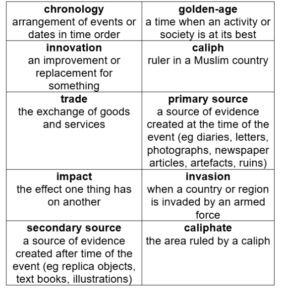
This half term, our classrooms’ have travelled back over 1,000 years as we launch into our brand-new history topic all about the Vikings in Britain. The children have started by placing the Vikings on a timeline, exploring where they fit within British and world chronology and discovering what else was happening around the globe while Viking longships were slicing through the seas.
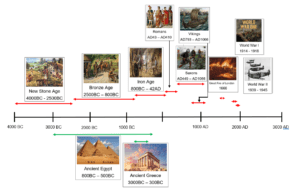
We have already zoomed in on one of the most famous moments in Viking history – the raid on Lindisfarne. The children were fascinated (and suitably shocked!) to learn how this peaceful monastery was attacked and why this event is often seen as the beginning of the Viking Age in Britain. There have been some excellent historical questions, thoughtful discussions and a few dramatic gasps along the way.
To bring the era to life even further, our new class novel this half term is Viking Boy by Tony Bradman. The children are loving following the story and using it to deepen their understanding of Viking life, beliefs and adventures, while also developing their reading and inference skills. We are very excited to see where the story (and our Viking journey) takes us next.
Help at Home: You can support your child by chatting with them about our new Viking topic and testing them on key vocabulary.
Reading: It’s so important!
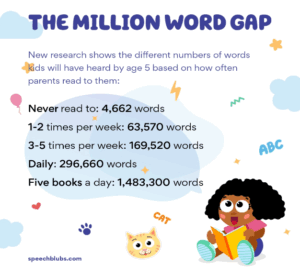
We hope that you’re enjoying reading your child’s library book with them. We call this a ‘love of reading’ book – to do just that, encourage a love of reading for your child! Reading to and with your child can have a huge positive impact on your child’s education.
This research is a powerful message of the impact you can have when reading to/with your child:
At school, your child reads a physical book four times a week – with a focus on teaching phonics skills. This is then sent home as an eBook. The purpose of the eBook at home is to celebrate your child’s success (in phonics skills). Your child should be able to read most of this book confidently and really feel like a reader.
We’ve chosen to use eBooks at home for many benefits. Allocating eBooks frees up about two hours of teacher or TA time changing books – now spent teaching reading!
Here’s some information on how to access eBooks but if you’re having any problems please speak to your child’s class teacher.
Happy reading!
Applying for a Reception Place
A quick reminder.
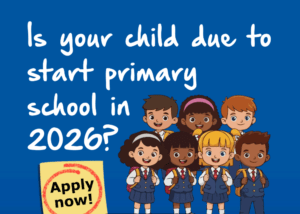
The closing date for applications for a September 2026 Reception place is 15 January 2026.
Please remember that you still need to apply for a Reception place at Scholes (Elmet) Primary School, even if your child attends Scholes Nursery.