
Our class novel
We are really getting into the class novel this half term – Letters from the lighthouse. The author is Emma Carroll who we know from earlier in the year when we read Secrets of the Sun King. The book links directly to our learning in topic about World War II. In the book, the main characters Olive and Cliff, are young children experiencing a war situation and are evacuated to the south coast for their safety. We follow their journey and experience the fear, emotion and moments of happiness with them.

Help at home: https://emmacarrollauthor.wordpress.com/
Use this website to learn more about the author with your child.
Science – investigating how bulbs grow in different temperatures
We are growing bulbs in science. In this investigation we will observe the bulbs growing in different temperatures – the warm windowsill in the classroom and the cold fridge. They will both be watered.
We will be observing over time (4 weeks), measuring and watching closely what happens. We made predictions when we set up our investigation.
Help at home by growing bulbs or seeds of your own, observing what happens as they grow. We’d love to see any photos of your plants. Email them to you teacher.
1A Mrs Wilkins : lydiawilkins@spherefederation.org
1,2B Mrs Latham : vickylatham@spherefederation.org
2C Miss Young : kateyoung@spherefederation.org


KS1 Reading – Amazing Grace

This half term we are sharing Mary Hoffman’s story ‘Amazing Grace’ in our classes. It’s a lovely story about a young girl named Grace who loves stories and using her imagination. She likes to dress up and act out her favourite tales. One day at school, Grace wants to play Peter Pan in the class play. But some kids tell her she can’t – because she’s a girl and because she’s Black. Grace feels sad, but with the love and encouragement of her Nana and Ma, she decides to try anyway. And guess what? She gives an amazing audition!
Help at home: Share the story with your child at home by clicking the link. This story teaches children that they can be anything they want to be, no matter what others say. What does your child want to be? You could discuss their hopes and dreams with them and relate it back to Grace from the story. Which character would they like to play from a book, programme, film or pantomime?
IA – What superstars!
What a great half term so far! 1A have returned to school with a fabulous attitude and an enthusiasm for learning this half term. They have, rightfully, earned the last 5 marbles for the class jar by engaging in learning and making good choices and they are well on the way to gaining all the healthy toppings for our pizza class reward chart. We had fun on the Adventure Playground as a fitting reward for filling the jar.


Keep it up 1A. You are amazing and we are so proud of you!
Wildflower garden – bug hotel
The new bug hotel was installed last week and we’ve started filling it to encourage the tiny animals to visit and live. We have added dry grass, fallen leaves, twigs, sticks, stones and pine cones so far.
We saw a ladybird, ants and a spider web in it already!
Help at home by sending in any small natural materials to fill the spaces or by creating your own bug hotel if you can!


Living and learning : Health and prevention (sleep)
We have been talking about the importance of sleep this week. We discussed activities that might help us relax or sleep and those that would not.
Help at home by ensuring your child gets enough sleep and has a regular bedtime routine.


Very Hungry Caterpillars
We were very excited in Nursery this week when a very special delivery arrived: a tub of our very own ‘Hungry Caterpillars’! We’re looking forward to watching them grow over the next few weeks. Our story of the week is ‘The Very Hungry Caterpillar’ – it’s taught us all about the life cycle of the butterfly and now we’ll be able to watch it for ourselves.


The children’s interest in minibeasts has continued in all of the Nursery provision. Outside, we’ve found lots of creatures hiding under logs including wood lice, spiders, slugs and some very long worms. Inside, we’ve been busy threading beads to make caterpillars and exploring our indoor small world area.


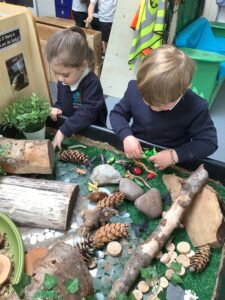
We’ve enjoyed the sunny weather this week, planting some more vegetables. We really have got green fingers !


We’ve also had lots of discussions about keeping safe in the sun. We know that we need to wear our sun hats, use sun cream and drink lots of water.
Help at home
Listen for the initial sounds in words. Find three objects, two that begin with the same sound and one that starts with a different sound. For example, car, cookie, banana. Can your child spot the odd one out? Say the name out loud, emphasising the initial sound.
Next week
Our Book of the Week is a poetry book. Your child will be able to identify the rhyming words.

Our Nursery Rhyme of the week is Incey Wincey Spider. You can sing this together at home.
Our Sound of the Week
Ww

Reminders
Sun safety
Please remember a sun hat, sun cream and water bottle. Please ensure that all sun cream is clearly named.
We hope that you have a happy and healthy long weekend. Nursery will open again next week on Tuesday 06 May.
The Very Hungry Caterpillar
Literacy
This week, we enjoyed reading a story that many of the children already know and love — The Very Hungry Caterpillar. Because the story is so familiar, it allowed children to join in with re-telling it, using the language and repeated refrains from the book. It was great to hear them confidently recalling key events and phrases, building their storytelling and early literacy skills along the way.

As a class, we then explored how we could change the story to create our own versions. Together, we came up with new character ideas — including The Very Hungry Bee! The children had great fun thinking of alternative foods that their character might eat, from strawberries and cake to honey and flower petals.
Maths
This week, we have continued to develop our subitising skills (see the quantity without counting) in complex arrangements.

We have explored creating arrangements of 6. The children explained how they could see 6.
I can see 3 and 3. I know that double 3 is 6.
There are 4 spots there and 2 there. 4 and 2 make 6.
That’s not six because there are 6 counters here and I can see one more.
Phonics
This week, we have continued to learn phase 4 words such as frog, shift, chimp and drum.
We’ve also learnt more phase 4 tricky words; some, come, love and do
Help at home- Please continue to work through the weekly learn at home phonics sheets, throughout the Summer term. We’ll continue to send these home each Friday.
Remember, there are lots of ‘tricky word games’ that we’ve shared in the past (see previous Class News posts) to help your child learn and remember these words. Thank you for your continued support — regular short practice sessions really help children consolidate their learning.
Poetry Picnic
Each week we learn a new poem and we recite this poem every day. By saying the poem out loud, we can focus on the sounds and rhythm of each word or line. We talk to the children about how this can help us become better readers. This week’s poem is called Under a Stone. Watch here.

Creative
Children have also enjoyed being creative with clay as part of their Expressive Arts and Design (EAD) learning. Inspired by our ongoing topic on minibeasts, they explored the shapes and features of tiny creatures like ladybirds, caterpillars and spiders. They rolled, pinched and shaped the clay to create their very own minibeast models.


More pictures of our learning this week…

Living and Learning: Health and Prevention
In the first two weeks of this half term, we’ve been learning all about health and prevention during our Living and Learning sessions.
Our two weekly statements were:
- I know the importance of personal hygiene; including handwashing.
- I know the importance of sleep.
During these sessions, we explored the importance of personal hygiene and the effects it could have on us if we don’t have good personal hygiene. Help at home: see if your child can explain why good personal hygiene (including handwashing) is important).
We also discussed the importance of sleep and the negative effects it can have on us if we don’t get enough sleep and if we aren’t in a good bedtime routine.
We concluded that these two things can be linked as well – for example: a good bedtime routine would involve brushing our teeth for two minutes on a night which is an example of good personal hygiene.
Help at home: see if your child can list some positive effects of a good nights sleep.
Working with decimal fractions!
This week in maths, we’ve been learning all about decimals—especially how to recognise tenths and hundredths as a decimal. We explored how 1/10 is the same as 0.1 and 1/100 is the same as 0.01. We used number lines and place value charts to help us understand. The classes did a fantastic job connecting their knowledge of fractions to decimals. Well done, everyone!
Help at home by continuing to support your child access TT rockstars