
Living and learning: democracy (JLT speeches)
Each child in key stage 1 had the opportunity to put themselves forward for the JLT (Junior Leadership Team) this week. They each did a little speech saying why we should vote for them.
Who would you choose?
I want to help school be healthy and happy.
I am kind and want to help people.
I want to help make money for other people.
I want to help school be happy and safe for everyone.
Help at home by talking about how democracy and voting is fair and ensures everyone can contribute.
Watch Us While We Work
Watch Us While We Work
Thank you to all parents and carers who made it to the Watch Us While We Work session this morning. If you couldn’t make it this time – don’t worry! There will be other sessions later in the year. This is what we talked about today:
Reading
We use a lot of different skills when we read. Many of these reading skills can be developed through very simple (but very effective) activities. Looking at, sharing and talking about pictures or photographs is a great way to develop inference, retrieval and choice skills (at school we refer to these as RICs). It’s a very quick and easy way you can help your child with reading skills at home.
Retrieval

Inference

Choice

We shared an example of using a picture to practise developing these reading skills

- Who are the characters?
- Why are they there?
- What ese can you see in the picture?
- I can see that they’re up above some clouds. Does anyone else know they’re up here?
- Do you think they’re friendly or fierce characters? How do you know?
- Are they friends with each other? Why?
- Is the dragon the girl’s pet? Or might the girl be the dragon’s pet? Why do you think that?
- They’re looking towards something. What are they looking at? Are they searching for something? What might it be?
- Why do you think the illustrator chose green scaly skin for the dragon?
- Why might the illustrator have given the girl a cape?
- What title would you give the picture/story?
Reading at home: Look at, share and discuss pictures in this way. It could be a picture from a page in a book, a poster, a leaflet or a family photograph. Any kind of picture discussed in this way will help your child with their retrieval, inference and choice skills.
Mathematics
We played some games with our adults which can be easily replicated at home. These games support children’s subitising, counting and calculating skills.
Game 1 – Counter Battle

Game 2 (version 1) – Wipeout

Game 2 (version 2) – Wipeout

Game 3 – Back and Forth

Mathematics at home: Play these games at home. They can be played with any resources you have to hand like paper, pens, pasta pieces or small toys such as cars for counters. If you don’t have any dice you could use electronic versions such as this one https://nrich.maths.org/interactive-environments/dice-and-spinners-interactive
Living and Learning: democracy
This week, our Living and Learning has been around one of the British Values, Democracy.
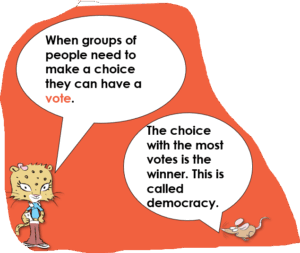
We use voting in our classroom to help us make decisions, such as choosing a class reward or deciding which book to read at story time.
This week, we’ll be holding our Junior Leadership Team (JLT) elections! On Thursday, the children who’d like to be part of the JLT will deliver their speeches to persuade their classmates to vote for them. They’ll need to think carefully about what would make them a good leader and what ideas they’d like to share with the JLT.
After listening to everyone’s speeches, we’ll have some tricky decisions to make as we head to the polling station to cast our votes! Every child will have the opportunity to have their say and use their democratic vote to choose who they’d like to represent our class on the JLT.
Help at home: Think about voting and why it is a fair way to make a decision. Are there any times you vote at home?
Poetry – There was an old man with a beard by Edward Lear
1,2B recited our poem all together this week. We were very proud of ourselves!
Speaking and listening: poetry
Last week, our poem of the week was There was an Old Man with a Beard by Edward Lear. This poem is from The Book of Nonsense.
This poem was chosen as part of National Poetry Day.
Help at home by practising this poem with your child. Make sure to encourage expression and voice projection.

English: Vlad and the Great Fire of London
We’re linking some of our reading and writing to our history topic. Vlad and the Great Fire of London tells the story from the viewpoint of a flea!
We’ll be using our comprehension skills in reading and then writing sentences too.

Help at home by reading the book to your child again and discussing it.
Living and Learning – I respect others
This week in our Living and Learning sessions, we explored what it means to respect others.

We began by thinking about what the words “respect” and “others” mean. We shared lots of thoughtful ideas, including:
We listen to each other.
We share and take turns.
We are kind and do not hurt others.
“Others” means everyone.
Together, we agreed that respect means thinking about other people and their feelings. We need to show respect to everyone, including people who may be different from us.
We talked about some of the ways people can be different. For example:
-
People may speak different languages.
-
People may look different, such as having different hair, eye or skin colours.
-
People may have different religions or beliefs.
-
People may be different genders.
-
People may be different ages or have different experiences and interests.
We learned that it is okay for people to be different from us. We should always treat others with kindness and respect, whatever their age, appearance, skin colour, language, beliefs, gender or background.
WE RESPECT EVERYONE! 🌟
Help at Home
Can you think of three ways that you are different from someone else?
You could think about your interests, favourite things, appearance, language, family, culture or things that make you unique.
PE
In PE, after warm-up games to get our bodies ready, we’ve been developing our fundamental movement skills through playing team games this half-term such as ‘lions and hyenas’.
The lions have to run to get ‘food’ (various items of equipment) and bring them home to their hoops. If they get caught by a hyena, they must drop the food and run back to the start.
Developing fundamental movement skills provides us with the building blocks to be successful in a range of sports and physical activities.
Help at home by doing something active together every day.


Conkers!
In 1,2B we’ve loved collecting conkers then using them to count, measure and play with. We collected 1690 in total. On Monday, as part of our science learning, we’ll be returning them to nature. We’ll throw them into the bushes and trees for the animals or for them to grow into trees one day.


Living and Learning – Manners and Courtesy

This week we have been thinking about manners. We talked about why we use them: to show respect and kindness to others and to make sure everyone is treated fairly.
We thought about examples of when we use good manners such as saying please and thank you, using good table manners and waiting for our turn to speak rather than interrupting (even when we are really excited to say something!).
Help at home by asking your child if they know why manners are important.
Children might also enjoy taking this quiz with you.