
Water Safety
Martin from the Canal and River Trust came to educate us about staying safe near water today. One of the main points he said was that swimming in a pool is best. Canals can be full of animal excretion that can lead to diseases.
Martin told us that we should never follow a friend into the water if they are struggling. Instead, we should call the emergency services to come. Whilst waiting for the fire brigade we could throw in a ball or an empty water bottle. These could help to keep our friend buoyant until help arrives. We might also look for a nearby life ring that we could throw into the water.
Even though you might be a strong swimmer you should always wear a life vest when participating in boating or water sports. If you bump your head and become unconscious, the life vest would save you from drowning.
The main message today was: ‘STAY AWAY FROM THE EDGE’ when near open water.
Have a very safe half term holiday!


Living and Learning : Staying Safe week in 1,2B
We’ve had a busy week learning all about how to stay safe. We’ve learned about saying safe online, at home, near the roads, near water, in the sun and out in the community. Buddy, from the NSPCC, taught us to ‘Speak out, stay safe.’
Help at home by helping your child learn to say their full name and address or telephone number.


Staying safe themed week – 1A
We have enjoyed learning all about staying safe this week. We have had visitors like fire fighters, police, water safety visitors and D-side.


We have also been learning lots about staying safe in class. We talked about being safe
- in ths sun
- online
- in school
- near traffic
- around dogs
We also discussed how each person’s body belongs to them and how to respect others.


Well done everybody for super listening and joining in all week!
Have a lovely, and safe half-term break!
Year 1 Maths
Year 1 have been busy this week, measuring things in and around the classroom.
We began our learning with measuring using non-standard units such as cubes.


‘Length is how long something is, from start to finish.’
‘Height is how tall something is, from the bottom to the top.’
We also used centimetres to measure small objects in our classrooms.
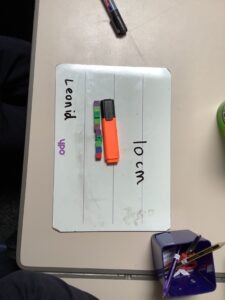


After this, we used rulers to measure objects accurately.

We need to line the object up with the end of the ruler, keep it straight and measure to the closest centimetre.
Help at home by making good estimations about how many centimetres long or tall, household objects are.
Living and Learning : Staying Safe themed week
This week, we’re learning all about staying safe and keeping ourselves safe.
There will be visitors and a change in lessons to cover all the areas below.
Help at home by talking to your child about risks and how they can stay safe at home, in the car and out in the community.

Science-deciduous or evergreen?
Through our Biology lessons, KS1 have been investigating the differences between deciduous and evergreen trees. We went onto the school field to observe the leaves and trees closely. We also had many examples of different leaves brought into school to help us with our learning. Our findings were:
Evergreen trees have spikey, dark green and waxy leaves.-Oliver
If there are no leaves on the tree in Winter, it will be deciduous!-Kit
Is that why you see holly at Christmas? It’s evergreen and you can get it in Winter.-Pheobe


To stay safe as Scientists: we were very careful when handling spikey clippings. We also washed our hands after touching them.
We wanted to gather and record simple data, so we took our tree classification sheet and set out onto the field again (hooray for the dry grass!)
We can identify the tree by looking at it’s leaves. The children were thrilled to independently identify the young horse chestnut trees. We are hoping to harvest conkers from them next Autumn. The limiting factor was that our classification sheet only had 9 different types of trees on it. These Scientists wanted to accurately name every tree and every bush.


Help at home: could you help your child to identify the trees, bushes and plants in your garden or local area? The woodland trust is a good place to start. It has an A-Z of British Trees.
Poem of the week
Our poem of the week this week is called ‘Morning Rush’ and it is about getting ready on a morning. We spotted many rhyming words and some repetition.
Everyone used their prosody to show expression, with some children using body language too.
Well done, KS1.

Help at home by continuing to practise the Poem of the Week every week. This is part of our homework and is sent home every Friday.
Living and Learning – Physical health and fitness
We’ve been learning about the importance of keeping active and have discussed what this looks like on the outside and inside of our bodies! We’ve thought about how we keep active during the school day, such as during WUSU and playtimes as well as PE lessons. We’ve also thought about ways we can keep active at home, whether that’s playing a sport, running around in the garden, going to the park or simply going for a walk.
Help at home by asking your child why it’s important for our health to keep active. Could they make a diary of all the active things they do in a week?
Maths, maths, maths
We’ve been busy learning new maths facts.
Year 1s have been learning doubles up to double 10 – they are tricky to remember. Hit the Button has a great doubles game.
Year 2s have been using a different game in Hit the Button to work on their multiplication and division facts.
Help at home by encouraging your child to learn these facts so they know them within a second or two!

Science – trees
We’re learning about plants in science. This week, we’ve started learning about deciduous and evergreen trees. We’ll be looking around the school grounds next week to find out which we have in school.
Help at home by identifying trees in your local area.